You stopped at last time.
The story in four panels
The backup generator that guards your memory
-
1The situation
Why do I keep forgetting things?
We say memory fades with age, yet some brains hold up to the end. Where does the difference come from?
-
2How it works
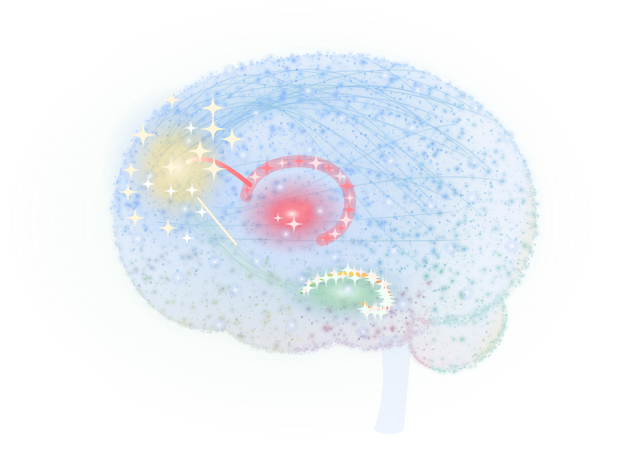
Backup generator, on!
In mice, the enzyme PLA2G2F released by hippocampal neurons reduced lipid droplets and inflammation in microglia. (Nature Neuroscience, 2026)
-
3What to do
Walk, sleep, learn
Brisk walks 3 times a week, 7 hours of sleep, something new to learn. Give the hippocampus room to work.
-
4The change
Still well connected!
A brain whose wiring stays intact keeps hold of memories with age. Walking, sleep and learning new things can give the hippocampus good conditions to work in.
The comic in words
- Panel 1 · The situation PictureA person slumped at a desk with an empty battery Speech bubble“Why do I keep forgetting things?”
- Panel 2 · How it works PictureWaste flowing out of the brain along a channel Speech bubble“Backup generator, on!”
- Panel 3 · What to do PictureA person jogging lightly Speech bubble“Walk, sleep, learn”
- Panel 4 · The change PictureTwo neurons joining firmly Speech bubble“Still well connected!”
📌 Key takeaways
The short answer: In brains that stay sharp with age, hippocampal neurons were switching on more of an enzyme called PLA2G2F. In mice, removing it worsened memory, and raising it protected memory in older mice. But it hasn’t been shown to work in people, and there are no drugs or supplements that raise it. What you can do now is create a good environment for your hippocampus through walking, sleep, and new learning.
- A study published in Nature Neuroscience in October 2026 found that neurons in the hippocampus, the gateway to memory, make more of a fat-breaking enzyme called PLA2G2F as we age. The team, led by Amar Sahay at Massachusetts General Hospital, described it as a “compensatory cognitive-resilience mechanism” that the brain switches on by itself.
- When the gene was removed in mice, brain inflammation and neuron damage got worse and memory test scores dropped. When its activity was boosted, synapses were preserved, inflammation fell, and older mice scored higher on memory tests.
- In an analysis of 13 human brains, the enzyme’s activity also rose with age and was highest in people who kept their thinking skills despite deposits of amyloid-beta, the protein linked to Alzheimer’s disease.
💬 “When I freeze in front of the fridge, is my brain just getting old?”
You have probably stood in front of an open fridge and stopped, wondering what you came for. A name sits on the tip of your tongue; something you just heard slips away. In those moments we quietly think: I must be getting older.
Yet look around and you’ll find people who seem to defy that. A grandmother in her eighties who never misses a grandchild’s birthday. A retiree who can still recite newspaper columns. They have lived through the same years. Why do some brains hold up to the end?
This study offers one clue. Inside the brains that hold up, a backup generator was running.
Deep Dive: the backup generator the hippocampus quietly switches on
1. Which part of the hippocampus weakens first with age?
New memories are stored by way of the hippocampus, deep in the brain. Its entrance, the dentate gyrus, keeps similar experiences from blurring together. It’s the reason you can remember where you parked yesterday separately from where you parked today.
The trouble is that the dentate gyrus is especially vulnerable to aging. Over time, the wires that connect neurons, the synapses, start to break one by one. The researchers asked a simple question: when synapses are lost, does the brain just take it, or does it switch on something to fight back?
2. What does the brain switch on when synapses start to fail?
The team searched for molecules that increase in dentate gyrus neurons when synapses disappear. What they found was PLA2G2F, a secreted phospholipase, an enzyme that cuts the fats (phospholipids) that make up cell membranes.
The striking part is that this enzyme is produced more as we get older. Just as a building’s basement generator starts up when the power fails, the hippocampus seems to switch on this generator by itself once aging begins to cut its wiring. Sahay called it a “compensatory cognitive-resilience mechanism.”
3. What happens to memory when this enzyme is turned off or up?
The researchers switched the gene off in the dentate gyrus of mice, and in other mice they turned it up.
| Experiment | What happened in the brain | Memory |
|---|---|---|
| Mice without PLA2G2F | More synapse loss, more inflammatory microglia, overactive astrocytes, less new-neuron formation, disrupted lipid metabolism | Memory scores dropped from middle age |
| Mice with boosted PLA2G2F | Synapses preserved, fewer inflammatory microglia and less glial activation | Older mice scored higher, and the curve of cognitive decline itself flattened |
| Boosted in an Alzheimer’s model | Less amyloid buildup | Memory improved |
With the generator off, the blackout spread faster. With it turned up, the lights stayed on longer.
4. How does this enzyme protect neurons?
So how does this generator deliver power? The key turned out to be microglia, the brain’s janitors and immune cells.
In the aging brain, lipid droplets gradually build up inside microglia. A separate 2020 study in Nature Neuroscience showed that these greasy microglia are in a broken state: they do a poor job of cleaning and pump out inflammatory signals instead. Think of a fan filter clogged with grease that moves no air and only makes noise.
To read the PLA2G2F findings together with walking research, go on to PLA2G2F and the continuous-walking study, which separates what’s confirmed from what isn’t.
In the new study, PLA2G2F released by neurons signaled to microglia and reduced those lipid droplets. With a clean filter, the janitor gets back to work, the noise of inflammation dies down, and the synaptic wiring breaks less often. Neurons look after their janitor neighbours, and the janitors in turn protect the neurons: a gentle, mutual loop.
5. Does the same thing happen in human brains?
The team also examined tissue from 13 human brains. The enzyme’s activity rose with age and was highest in people who had kept their cognitive abilities in life even though amyloid-beta, the protein linked to Alzheimer’s disease, had built up in their brains.
Scientists have long called this, signs of disease with no symptoms, cognitive reserve. This study shows what one piece of that reserve power might be made of at the molecular level. Timothy Hohman, a neuroscientist at Vanderbilt University who was not involved, called it “a fantastic, very thoughtful approach to get at what could be protecting neurons.”
6. How far can we take these results?
There is something to say honestly here. It has not been shown that raising this enzyme’s activity would prevent memory loss or dementia in people. The human data come from a small sample of 13 brains and show a link, not cause and effect. And there is no drug or supplement that raises this enzyme directly. If you see a product advertised as boosting it, be careful.
So the real message of this study is not “go find this enzyme,” but this: the brain does not simply give way to aging; it has machinery that fights back. What we can do is make the conditions good for that machinery to work.
Solution: three steps to protect your hippocampus
The habits below have not been shown to raise PLA2G2F directly. They are habits that other research has repeatedly linked to hippocampal health and cognitive reserve. Think of them as improving the power supply for the whole building, so the backup generator can keep going longer.
- Fuel the hippocampus: brisk walking, 40 minutes, 3 times a week. When 120 adults aged 55 to 80 did walking exercise three times a week for a year, their hippocampal volume grew by about 2%, while the stretching-only group’s shrank by about 1.4% (PNAS, 2011). The hippocampus is a generator that responds honestly to exercise. Aim for a pace where you’re slightly out of breath: you could talk, but not sing.
- Give the janitors their shift: sleep 7 hours or more. During sleep the space between brain cells widens, and waste such as amyloid-beta is washed out much faster than when we’re awake (Science, 2013). Sleep is the cheapest way to keep microglia from clogging up. Dim your screens in the hour before bed.
- Lay spare wiring: learn one unfamiliar thing each day. The core finding of cognitive reserve research is that people with more education, social connection and new learning show symptoms later even when brain damage is present (Lancet Neurology, 2012). Take a new route home, learn five words of a foreign language, cook something you’ve never made. Unfamiliar tasks lay new wiring.
First, check your current habits. For each item you select, you’ll see something you can try right away.
| Step | What to do | How much | What you can expect in the hippocampus |
|---|---|---|---|
| 1. Fuel | Brisk walking | 3 times a week, 40 min | Hippocampal volume kept or increased, better memory |
| 2. Cleaning | Enough sleep | 7+ hours nightly | Waste cleared, less strain on microglia |
| 3. Spare wiring | New learning, conversation | One thing a day | Greater cognitive reserve, later onset of symptoms |
Conclusion
Even if moments of freezing in front of the fridge become more frequent, the brain doesn’t simply give way. What the research showed is that when synapses start to fail, the aging hippocampus switches on an enzyme called PLA2G2F and fights back on its own. But these results come from mice and a small number of human brains, and there are no drugs or supplements that raise this enzyme. What we can do is create a good environment for the hippocampus through walking, sleep, and new learning. Today, start by making time for a brisk walk.
Frequently asked questions
Are there foods or supplements that increase PLA2G2F?
Not at present. The study raised the enzyme by delivering the gene directly into mouse brains, and no method for people has been developed yet. The researchers hold a related patent, so treatment research may follow, but until then you can assume that products labelled as a “PLA2G2F booster” have no scientific basis. The best thing you can do now is to create good working conditions for your hippocampus, as in the three steps above.
I’ve been forgetting things more often. Is this the start of dementia?
Briefly losing a name or forgetting where you put something is common with age, and most of the time it has nothing to do with dementia. But if you get lost on familiar routes, ask the same question repeatedly, or find daily life affected, please see your doctor or a memory clinic for an assessment. As this study shows, the ability to withstand changes in the brain differs from person to person, and the earlier you know, the more you can do.
References
- Memory stays strong in old age when this brain enzyme is active. (2026, October 16). Nature (News). doi:10.1038/d41586-026-03303-9
- Vicidomini, C., Goode, T. D., McAvoy, K. M., … Sahay, A. (2026). An aging-sensitive secreted phospholipase confers neuroprotection and cognitive resilience. Nature Neuroscience (published online October 15, 2026). Preprint: bioRxiv (2024), doi:10.1101/2024.07.26.605338. doi:10.1038/s41593-026-02465-z
- Marschallinger, J., Iram, T., Zardeneta, M., … Wyss-Coray, T. (2020). Lipid-droplet-accumulating microglia represent a dysfunctional and proinflammatory state in the aging brain. Nature Neuroscience, 23, 194–208. doi:10.1038/s41593-019-0566-1
- Erickson, K. I., Voss, M. W., Prakash, R. S., … Kramer, A. F. (2011). Exercise training increases size of hippocampus and improves memory. PNAS, 108(7), 3017–3022.
- Xie, L., Kang, H., Xu, Q., … Nedergaard, M. (2013). Sleep drives metabolite clearance from the adult brain. Science, 342(6156), 373–377.
- Stern, Y. (2012). Cognitive reserve in ageing and Alzheimer’s disease. The Lancet Neurology, 11(11), 1006–1012. doi:10.1016/s1474-4422(12)70191-6
A question for you
Is there someone in your life whose memory has stayed sharp with age? What do they do each day? Tell us about their habits on the contact page. The “brain that holds up” you’ve seen could be the starting point for the next post.
Disclaimer
This article provides general health information based on academic research and is not a substitute for medical diagnosis or treatment. The key findings of the study described here come from animal experiments and analysis of a small number of human brain tissue samples; a therapeutic effect in people has not yet been confirmed. If you are worried about memory decline, or have a medical condition and plan to start a new exercise routine, please talk to a healthcare professional first.
Information current as of . Newer research may change these conclusions.
Was this article helpful?
Your choice is saved only in this browser and is never sent anywhere.