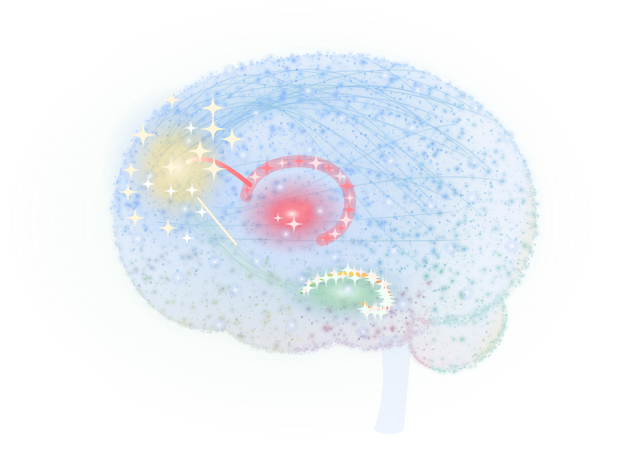
You stopped at last time.
The story in four panels
Is one long walk better for the brain?
-
1The worry
Hit 10,000, but…
The step count is there, but it's all scraps of steps. Does the way you walk matter too?
-
2How PLA2G2F works
Let me clear that grease
In mouse brains, PLA2G2F, an enzyme released by hippocampal neurons, shrank the fat droplets in microglia and protected memory. (Nature Neuroscience, 2026)
-
3The walking research
Does walking longer help?
People who took most of their steps in bouts of 15 minutes or more had lower cardiovascular risk (an observational study). There is no study yet showing that walking raises this enzyme.
-
4The takeaway
Total first, then 15 minutes
Keep your scraps of steps and fill up your total first, then add one 15-minute unbroken walk a day.
The comic in words
- Panel 1 · The worry PictureA person with a lowered head beside an almost empty battery Speech bubble“Hit 10,000, but…”
- Panel 2 · How PLA2G2F works PictureWaste draining out of the brain along a path Speech bubble“Let me clear that grease”
- Panel 3 · The walking research PictureA person walking beside a tree in the sunshine Speech bubble“Does walking longer help?”
- Panel 4 · The takeaway PictureA staircase climbed step by step with a flag at the top Speech bubble“Total first, then 15 minutes”
📌 Key takeaways
The short answer: For your body, possibly. Among people who walk little, those who took most of their steps in unbroken bouts of 15 minutes or more had a 9.5-year rate of cardiovascular disease of 4.39%, about a third of the 13.03% seen in people whose walks lasted under 5 minutes. But this was an observational study, and no research yet shows that walking raises the brain’s shield enzyme PLA2G2F. Meeting your daily total while adding one 15-minute unbroken walk is what fits the current evidence.
- 🛡️ In a study published in Nature Neuroscience in October 2026, neurons in the hippocampus, the gateway to memory, made more of a phospholipid-cutting enzyme called PLA2G2F as they aged. In mice, the enzyme shrank the lipid droplets clogging the brain’s cleaners, the microglia, calmed inflammation, and protected synapses and memory. In human brains, its activity was highest in people who kept their cognition intact even though amyloid-beta had built up.
- 🚶 In a study of 33,560 UK adults published in Annals of Internal Medicine in 2025, among people walking 8,000 steps a day or fewer, those who took most of their steps in unbroken bouts of 15 minutes or more had a 9.5-year cumulative cardiovascular disease incidence of 4.39%, lower than the 13.03% seen in people whose steps came in bursts of under five minutes. This was an observational study, however, so it does not prove cause and effect.
- 🧠 People who walked more showed slower cognitive decline even with amyloid in their brains (Nature Medicine, 2025), and the microglia of older mice that exercised looked more like young microglia (Aging Cell, 2024).
- ⚖️ But no study has yet shown that walking or exercise raises PLA2G2F. The idea that “a long walk burns fat, so it clears the grease from your brain too” is also unverified. This article separates what has been shown from what we still don’t know.
💬 “I hit 10,000 steps today. Does the way I walk matter too?”
Open the health app on your phone and the number glows: 10,214 steps. Goal reached again. But trace those steps back one by one and it gets a little embarrassing. Desk to restroom, parking lot to elevator, back and forth between supermarket aisles. Every one of them a one- or two-minute scrap of steps.
Step counts don’t lie. Whether they tell the whole story is another question. Two recent studies speak to it. One found a shield inside the brain that protects memory even when dementia pathology is present. The other offered a clue that the same steps might carry different risks depending on how you take them. Put them side by side, and it’s tempting to hope: “So if I walk without stopping, does my brain’s shield get stronger?” This article follows that hope only as far as the research actually goes.
Deep Dive: the brain’s shield and walking research, and how much we really know
1. A shield the brain raises on its own: PLA2G2F
Professor Amar Sahay’s team at Massachusetts General Hospital looked for what neurons in the dentate gyrus, the entrance to the hippocampus, start producing when synapses disappear. What they found was PLA2G2F, a secreted phospholipase that cuts the fats (phospholipids) that make up cell membranes (Vicidomini et al., Nature Neuroscience, 2026).
This enzyme behaves a lot like a shield on a castle wall. It stays quiet most of the time, but as we age and the wall of synapses starts to crumble piece by piece, more shields go up.
- When the gene was deleted in mice, synapse loss, inflammatory microglia, overactive astrocytes, impaired birth of new neurons, and disrupted lipid metabolism all got worse, and memory declined.
- When it was boosted instead, synapses were preserved, inflammation fell, and the curve of memory decline itself flattened in older mice. In a mouse model of Alzheimer’s disease, amyloid buildup also fell.
- The enzyme released by neurons shrank the lipid droplets in neighboring microglia. In human microglia, too, lipid droplets and cholesterol esters decreased.
- In human brain tissue, the enzyme’s activity rose with age and was highest in people who kept their cognition despite amyloid-beta buildup. In other words, the team found one molecule linked to the ability to stay symptom-free despite signs of disease, known as cognitive resilience.
Why are lipid droplets a problem? It was already shown in 2020 that when lipid droplets build up in the microglia of an aging brain, the cells slip into a broken state, failing at cleanup while pumping out inflammatory signals (Marschallinger et al., Nature Neuroscience, 2020). It’s like a vent filter so caked with grease that it makes noise instead of moving air. PLA2G2F is the hand that wipes that filter clean. You can find the full story of the enzyme in People Whose Memory Holds Up With Age Had a ‘Backup Generator’ Running in Their Brains.
There’s one point to keep firmly in mind. The researchers changed enzyme levels by delivering the gene directly into mouse brains. No way for people to raise this enzyme, whether a drug, a food, or a form of exercise, has been identified yet.
2. Same 10,000 steps, different results? Broken-up steps vs. unbroken steps
An international team fitted 33,560 UK Biobank participants who walked 8,000 steps a day or fewer with wrist accelerometers for up to seven days (Del Pozo Cruz et al., Annals of Internal Medicine, 2025). They then sorted people not by how many steps they took, but by how many minutes at a stretch they took most of those steps, and followed them for an average of about eight years.
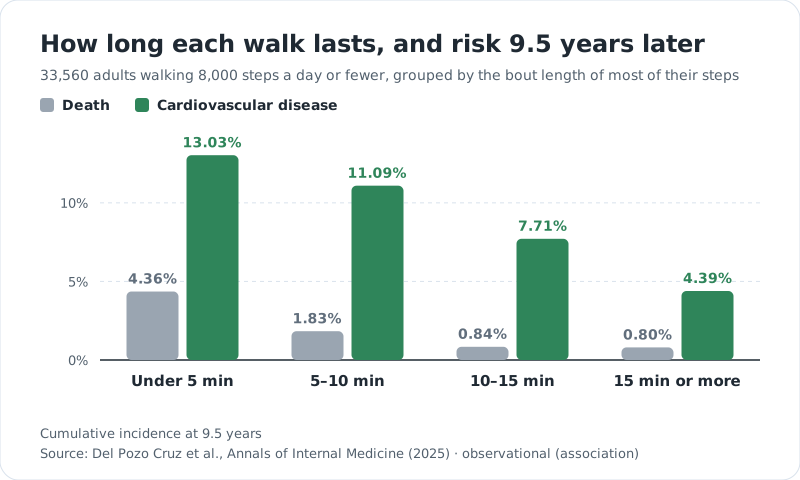
| Bout length for most steps | 9.5-year cumulative death rate | 9.5-year cumulative cardiovascular disease rate |
|---|---|---|
| Under 5 minutes | 4.36% | 13.03% |
| 5–10 minutes | 1.83% | 11.09% |
| 10–15 minutes | 0.84% | 7.71% |
| 15 minutes or more | 0.80% | 4.39% |
The longer people walked without stopping, the more risk dropped like a staircase. The researchers reported that the gap was larger among people walking fewer than 5,000 steps a day. An accompanying editorial suggested that future physical activity guidelines should include not just step counts but step patterns.
To learn more about what PLA2G2F does in the hippocampus, read the PLA2G2F study on the hippocampus’s backup generator, built around the original paper.
When reading these results, though, keep four things in mind.
- It’s an observational study. People weren’t randomly assigned to groups, so this is an association, not cause and effect. It remains possible that people who were healthier to begin with were simply able to walk for longer stretches.
- The 15-minutes-or-more group was small, so its figures have wide margins of error.
- The longest category compared was “15 minutes or more”; the study did not look separately at 30 or 60 minutes.
- The results concern death and cardiovascular disease. The study did not measure the brain, cognition, or PLA2G2F.
So what this study lets us say is not “never break up your steps,” but something closer to “if you walk relatively little, walking without stopping may be better for your heart.”
3. A common misconception: “A long walk burns fat, so it clears the grease from your brain too?”
Put the two studies side by side, and it’s tempting to build a story: “A long walk burns fat, which shrinks the lipid droplets in microglia and makes things easier for PLA2G2F.” It sounds plausible, but it is not a connection research has confirmed.
- It’s true that your fuel mix changes the longer you exercise. In endurance-trained people exercising at moderate intensity for two hours, the share of energy coming from fuel carried in the blood, especially fatty acids, rose over time, in place of glycogen and fat stored in the muscle (Romijn et al., American Journal of Physiology, 1993). But this is a study of what the muscles burn.
- The brain’s main fuel is glucose, and there is no research showing that burning more fat in the body shrinks the lipid droplets inside the brain’s microglia. Burning fuel in muscle and grease inside brain cells are separate matters.
There is something that reliably does happen in the brain while you walk. Exercising at moderate intensity raises brain activity and metabolism, which increases blood flow to the brain; at high intensity, when you’re too out of breath, that rise falls back again (Ogoh & Ainslie, Journal of Applied Physiology, 2009). Walking at a pace where you can talk but not sing is the intensity that opens a generous channel of blood through the brain’s vessels. Whether this rise in blood flow has anything to do with PLA2G2F, however, has also never been studied.
4. Walking and the brain: what has been shown
They don’t tie directly to PLA2G2F, but several studies link walking and exercise to good outcomes for the hippocampus, microglia, and cognition, the very things this enzyme is trying to protect.
- Hippocampal size: When 120 people aged 55 to 80 walked three times a week, 40 minutes at a time, for a year, the volume of their anterior hippocampus grew by about 2%, while the stretching-only group’s shrank by about 1.4% (Erickson et al., PNAS, 2011). As a randomized controlled trial, this is the strongest evidence in this article. Walking started at 10 minutes and built up to 40 minutes over several weeks. This trial did not, however, compare broken-up and unbroken walking.
- Slower cognitive decline even with amyloid: The Harvard Aging Brain Study followed 296 cognitively healthy people aged 50 to 90 for up to 14 years. Even among those with high levels of amyloid in the brain, more daily steps were linked to slower buildup of tau protein and slower cognitive decline. Walking 3,000–5,000 steps a day was associated with a delay in decline of about three years on average, and 5,000–7,500 steps with about seven years (Yau et al., Nature Medicine, 2025). This study looked at total daily steps, not whether they were taken in one go. It is observational, so it remains possible that people who were healthier to begin with simply walked more.
- Microglia: When 18-month-old female mice were given free access to a running wheel for three weeks, about 90% of the 310 microglial genes that had shifted with age no longer differed from those of young mice, and the birth of new neurons in the hippocampus rose (Chauquet et al., Aging Cell, 2024). It’s a mouse study, and it did not measure lipid droplets.
Look again at the second study: people who kept their memory even with amyloid built up. It resembles what the PLA2G2F study found in human brains. One looked at a molecule, the other at a daily habit, but both point toward the same question: a brain that doesn’t collapse in the face of disease. Whether the two are looking at the same pathway, though, nobody knows yet.
5. Summing up: what’s been shown and what we don’t know
| Question | The answer so far | Type of evidence |
|---|---|---|
| Does PLA2G2F protect memory? | Yes in mice; only an association in people | Animal experiments, human brain tissue |
| Does walking raise PLA2G2F? | Unknown. No studies | None |
| Does a long walk shrink lipid droplets in the brain? | Unknown. No studies | None |
| Is unbroken walking better than broken-up steps? | Linked to lower cardiovascular and death risk | One observational study |
| Is walking good for the hippocampus and cognition? | Evidence for this keeps building | Randomized controlled trials, observational studies |
So we can’t call walking “raising the shield.” What we can say for now is that walking helps strengthen the castle the shield guards, namely the hippocampus and blood vessels. If you see a supplement, food, or exercise program advertised as “boosting PLA2G2F,” you can assume it has no scientific basis.
The fix: three evidence-based walking steps
- Step 1: Fill up your total first. The firmest evidence is about how much you walk more than how long you walk without stopping. The World Health Organization recommends 150–300 minutes of moderate physical activity a week for adults, and its 2020 guidelines dropped the rule that activity only counts if it lasts a certain number of minutes. Every scrap of steps counts. In the study where cognitive decline was slower in people with amyloid, the biggest differences were in the range of 3,000 to 7,500 steps a day.
- Step 2: Add one 15-minute unbroken walk a day. Put one solid block on top of your total. Get off one stop early on the way to work, or loop once around the office after lunch. Pick a route with few traffic lights and stairs, and walk for 15 minutes without stopping. The group with the lowest cardiovascular risk was the people who took most of their steps in bouts of 15 minutes or more.
- Step 3: Build up to 30–40 minutes over several weeks, at a pace where you can still talk. The trial in which hippocampal volume grew started at 10 minutes, built up to 40 minutes over several weeks, and kept it up three times a week for a year. Aim for a pace where you can talk but not sing. Attaching the walk to something you already do, such as “right after lunch” or “sneakers on after the evening dishes,” helps you keep it going without leaning so hard on willpower.
Below is an example of spreading the three steps across a day. Tap each step to see how.
| Step | What | How much | Evidence | What the evidence showed |
|---|---|---|---|---|
| 1. Total | Increase daily steps and active time | 150–300 minutes a week, scraps of steps included | WHO guidelines (2020), Nature Medicine (2025) | An association between walking more and slower cognitive decline |
| 2. A block | Walk 15 minutes without stopping | Once a day | Annals of Internal Medicine (2025) | An association with lower cardiovascular and death risk |
| 3. Time and pace | 30–40 minutes at a talking pace | 3+ times a week, building up over several weeks | PNAS (2011), J Appl Physiol (2009) | Larger hippocampus (trial); more blood flow to the brain during exercise |
Conclusion
The brain doesn’t simply crumble in the face of aging and dementia. In mice, the hippocampus raised a shield called PLA2G2F when synapses started to break, and in human brains, people with more of this shield held on to their memory in the face of disease. We don’t yet have a way to lift that shield directly, and walking is no exception. But walking is one of the few things with steadily growing evidence that it strengthens the castle the shield guards: the hippocampus and the blood vessels. Fill up your total steps first, then add one unbroken walk a day.
Frequently asked questions
I don’t have time, so I walk in 10-minute pieces. Is that useless?
Not at all. In its 2020 guidelines, the World Health Organization dropped the old minimum-duration rule that activity only “counted” if it lasted a certain number of minutes. Movement of any length beats sitting. The unbroken-walking study doesn’t say broken-up steps are harmful either. It says that, among people who walked relatively little, walking without stopping was linked to better outcomes. Keep your short walks, and try adding one day at a time, even a few days a week, on which you walk 15 minutes or more without stopping.
Is it okay to walk for a long time if my knees hurt or I’m older?
Starting slowly on flat ground is fine for most people, but if you have joint disease, heart disease, or dizziness, talk to your doctor first. If walking is hard, you can build up your active time with lower-impact exercise such as an indoor bike or water walking. What matters more than the activity is keeping it up consistently.
References
- Vicidomini, C., … Sahay, A. (2026). An aging-sensitive secreted phospholipase confers neuroprotection and cognitive resilience. Nature Neuroscience. doi:10.1038/s41593-026-02465-z
- Del Pozo Cruz, B., Ahmadi, M., Sabag, A., Saint-Maurice, P. F., Lee, I.-M., & Stamatakis, E. (2025). Step accumulation patterns and risk for cardiovascular events and mortality among suboptimally active adults. Annals of Internal Medicine, 178(12), 1718–1727. doi:10.7326/ANNALS-25-01547
- Marschallinger, J., … Wyss-Coray, T. (2020). Lipid-droplet-accumulating microglia represent a dysfunctional and proinflammatory state in the aging brain. Nature Neuroscience, 23, 194–208. doi:10.1038/s41593-019-0566-1
- Romijn, J. A., … Wolfe, R. R. (1993). Regulation of endogenous fat and carbohydrate metabolism in relation to exercise intensity and duration. American Journal of Physiology–Endocrinology and Metabolism, 265, E380–E391. doi:10.1152/ajpendo.1993.265.3.e380
- Ogoh, S., & Ainslie, P. N. (2009). Cerebral blood flow during exercise: mechanisms of regulation. Journal of Applied Physiology, 107(5), 1370–1380. doi:10.1152/japplphysiol.00573.2009
- Chauquet, S., … Vukovic, J. (2024). Exercise rejuvenates microglia and reverses T cell accumulation in the aged female mouse brain. Aging Cell, 23(7), e14172. doi:10.1111/acel.14172
- Yau, W.-Y. W., Kirn, D. R., Rabin, J. S., … Chhatwal, J. P. (2025). Physical activity as a modifiable risk factor in preclinical Alzheimer’s disease. Nature Medicine. doi:10.1038/s41591-025-03955-6
- Erickson, K. I., … Kramer, A. F. (2011). Exercise training increases size of hippocampus and improves memory. PNAS, 108(7), 3017–3022.
- World Health Organization. (2020). WHO guidelines on physical activity and sedentary behaviour.
A question for you
What was the longest unbroken stretch of walking in your day? If you added just five minutes to it tomorrow, which route would you like to walk? Tell us about your own walking route on the contact page. Your walking story could be where our next article begins.
Disclaimer
This article provides general health information based on academic research and does not replace medical diagnosis or treatment. The core findings of the PLA2G2F study come from animal experiments and analyses of human brain tissue, and no study has yet shown that walking or exercise raises this enzyme. Of the human walking studies in this article, all except the hippocampus study (a randomized controlled trial) are observational and do not prove cause and effect. If you have a medical condition or plan to start a new exercise routine, please talk to your doctor first.
Information current as of . Newer research may change these conclusions.
Was this article helpful?
Your choice is saved only in this browser and is never sent anywhere.