You stopped at last time.
The story in four panels
Same pain, different paths: benign and malicious envy
-
1The situation
Congrats!… (so why does it sting?)
The sting that hits after you tap ‘like’ on a friend's promotion. Four hundred years ago, Iago began his story with the same feeling.
-
2How it works
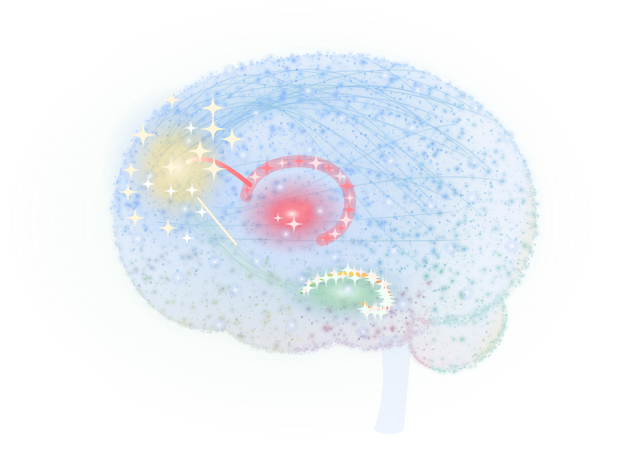
The pain of comparison is real
The more people felt they had fallen behind, the more strongly the pain-related anterior cingulate cortex lit up. (Science, 2009)
-
3What to do
Lift yourself, don't pull them down
The same pain becomes benign envy when it lifts you up and malicious envy when it pulls others down.
-
4The change
Envy became my next goal
Benign envy, which lifts you up, drove more effort than simple admiration. (PSPB, 2011)
The comic in words
- Panel 1 · The situation PictureA tired person slumped at a desk Speech bubble“Congrats!… (so why does it sting?)”
- Panel 2 · How it works PictureTwo neurons joining Speech bubble“The pain of comparison is real”
- Panel 3 · What to do PictureA person jogging lightly Speech bubble“Lift yourself, don't pull them down”
- Panel 4 · The change PictureSmall repeated steps up a staircase towards a goal flag Speech bubble“Envy became my next goal”
📌 Key takeaways
The short answer: When you feel you have fallen behind someone else, a pain-related region of the brain, the anterior cingulate cortex, really does become active (Science, 2009).
The same pain becomes benign envy that drives growth when it lifts you up, and malicious envy that leads to ruin when it pulls others down.
💬 The sting after tapping “like”
It’s 11 p.m., and out of habit you open social media before bed. A college classmate has posted news of a promotion. Under a photo of the new business card, congratulations pile up. You tap the heart and type “Congrats!” You mean it. But the moment you put the phone down, something just under your ribs begins to sting.
“What have I been doing all this time? They were always the lucky one.” You dislike yourself for thinking it, so you pick the phone up again and scroll through someone else’s travel photos and someone else’s new apartment. The sting doesn’t fade. It grows.
Korean has a saying that captures this feeling exactly: “When your cousin buys land, your stomach aches.” Was that just the wit of earlier generations? Brain-imaging research has shown that the sting of comparison really does activate brain regions involved in pain. And four hundred years ago, Shakespeare wrote a whole tragedy about how far that pain can take a person when it flows the wrong way.
📖 Jump to Shakespeare’s four great tragedies and the full plot of Othello ↓
🔬 Deep Dive: How does the same pain split into benign and malicious envy?
In Othello, one of Shakespeare’s four great tragedies, the ensign Iago envies his fellow officer Cassio, who was promoted to lieutenant instead of him. Iago then plants a suspicion in the mind of their commander, the general Othello, that his wife Desdemona and Cassio are too close, and in the end drives them all to tragedy. Let’s follow what happens inside Iago’s mind, and inside our own brains.
Does envy really hurt?
An experiment by a team at Japan’s National Institute of Radiological Sciences, published in Science in 2009, answered this question head-on. Participants read short stories in which they themselves were the main character. Three former classmates appeared in the stories.
- A: better than me in grades, looks and popularity, and with dreams and interests similar to mine
- B: better than me, but with dreams and interests completely different from mine
- C: average, and with interests different from mine
Participants felt the strongest envy toward A. When the researchers looked at the brain with fMRI, the stronger that feeling, the greater the activity in the anterior cingulate cortex (dorsal ACC) (Takahashi et al., Science, 2009).
The anterior cingulate cortex is known as a region that responds both when the body hurts and when the heart hurts. In a ball-tossing game where two other players stopped passing the ball to the participant, this region also lit up, and the stronger the response, the more distressed participants said they felt (Eisenberger et al., Science, 2003). Because this region also helps detect conflict and control attention, though, it is more accurate to say that the pain of comparison is processed where it overlaps with the brain’s pain-processing circuitry than to say it is identical to physical pain. The study also had only 19 participants, and some neuroscientists have cautioned that because the anterior cingulate cortex lights up in so many situations, we should be careful about reading this result as a signal unique to envy.
Why does a classmate’s promotion hurt more than a celebrity’s success?
In the experiment, the person who caused the most pain was not simply someone better (B) but someone better who walks the same path as me (A). The psychologist Abraham Tesser explained this with his self-evaluation maintenance model. We feel most threatened when someone close to us outperforms us in a domain we care about (Tesser, Advances in Experimental Social Psychology, 1988). For Iago, Cassio was exactly that person: serving under the same general, competing for the same lieutenancy.
Social media brings this pain back every night. In a study that used an experiment and day-by-day tracking to examine passive Facebook use (scrolling through other people’s posts without posting or chatting), the more time people spent passively scrolling, the worse they felt that day, and the feeling linking the two was precisely this sting of comparison: envy (Verduyn et al., Journal of Experimental Psychology: General, 2015). Placing our ordinary day next to other people’s brightest moments gives the anterior cingulate cortex no rest.
Where do benign and malicious envy part ways?
Up to this point, everyone feels the same pain. The fork comes next. A team at Tilburg University in the Netherlands collected people’s real experiences and showed that the pain of comparison flows in two directions (van de Ven et al., Emotion, 2009).
- Benign envy: “I want to be like that too.” The pain points toward lifting myself up. It leads us to learn from the other person and to try harder.
- Malicious envy: “I wish they’d be brought down.” The pain points toward pulling the other person down. It leads us to belittle them and to hope they fail.
The key point is that both feelings sting the same at first. Benign envy is not painless; it simply uses the pain in a different direction. And the direction changed the outcome completely. In a follow-up study, people who felt benign envy worked longer and harder on a task than people who simply admired the other person (van de Ven et al., Personality and Social Psychology Bulletin, 2011). Admiration stops at “that’s impressive,” while benign envy carries on to “let me try too.” This effect appeared, however, only when participants believed that with effort, they too could improve. When they believed improvement was hard, the same comparison ended in admiration and did not make them try harder.
What decides the direction? The same team found that the more undeserved another person’s success seemed, the more the pain flowed into malicious envy, and that benign envy was strongest when the success seemed deserved and within one’s own reach (van de Ven et al., Motivation and Emotion, 2012). Interestingly, these judgments did not change how strong the pain was; they changed only which way it flowed. In the play’s very first scene, Iago belittles Cassio like this: “a great arithmetician … That never set a squadron in the field” (Act 1, Scene 1). The moment he believed Cassio’s promotion was undeserved, Iago’s pain set off down the path of malicious envy.
Why didn’t Iago stop?
Where does pain go once it takes the path of malicious envy? The Science experiment above had a second part. When the researchers had participants read stories in which misfortune befell the envied classmate A, the brain’s reward circuit, the striatum, lit up. This is the pleasure we take in someone else’s misfortune, known in German as Schadenfreude. And the people whose anterior cingulate cortex had responded most strongly at first also showed the strongest striatal response (Takahashi et al., Science, 2009).
Envy begins as pain and turns into reward when the other person falls. For Iago, the downfall of Cassio and Othello may have been a reward that soothed that pain. Shakespeare never fully explains why Iago went so far, but Iago introduces himself this way: “I am not what I am” (Act 1, Scene 1). A loyal subordinate on the outside, a man in the grip of envy’s circuitry on the inside. And at the end of that road lay not only the ruin of Cassio and Othello but Iago’s own.
Why did Othello fall apart over a single handkerchief?
Othello holds one more emotion besides envy. The psychologists Gerrod Parrott and Richard Smith distinguished the two like this (Parrott & Smith, Journal of Personality and Social Psychology, 1993). Envy is a two-person emotion about wanting what someone else has; jealousy is a three-person emotion about fearing the loss of a cherished relationship. Iago envied Cassio, and he used that envy as a weapon to plant jealousy in Othello’s heart.
Once jealousy took root, the way Othello fell apart matches confirmation bias exactly. People readily accept information that supports what they already believe and let contradicting information slip by (Nickerson, Review of General Psychology, 1998). With suspicion planted, Desdemona’s kindness and her explanation that she had lost the handkerchief all looked like evidence. Just as Iago calculated, “trifles light as air” became “proofs of holy writ.” That is Othello: a story in which one man’s envy fed another man’s jealousy until it destroyed them all.
| Question | What research showed | The scene in Othello |
|---|---|---|
| Does envy really hurt? | The more people felt they had fallen behind, the more strongly the pain-related anterior cingulate cortex lit up. | The sting Iago felt after being passed over. |
| Why do people close to us hurt more? | A close person pulling ahead in our own field caused the most pain. | Cassio, who competed for the same post. |
| Where do benign and malicious envy part ways? | The same pain becomes benign envy when it lifts you up and malicious envy when it pulls others down. Success that seems undeserved tends to push it toward malicious envy. | Iago belittling Cassio as an “arithmetician.” |
| Where does malicious envy lead? | When the envied person suffered, the reward circuit lit up, more so in those who envied more. | Iago, who doesn’t stop as he brings down Cassio and Othello. |
| Why can one handkerchief become proof? | Because of confirmation bias, which picks out only what we already believe. | Othello, who suspected his wife over a single handkerchief. |
If you wonder why reaching out first instead of pulling others down comes back to you in the end, read If Genes Are Selfish, Why Do We Help Others?, and for how to step back from stinging thoughts that keep circling, see Thoughts Are Not You.
✅ The fix: Three steps to choose benign envy over malicious envy
Step 1: Name the sting
When your stomach starts to ache, don’t ignore the feeling or scold yourself with “Why am I so petty?” Instead, say it out loud or write it down: “Ah, right now I envy ○○.”
Simply naming a feeling changes the brain. People who looked at emotional faces and chose a word for the feeling, such as “angry” or “afraid,” showed a smaller response in the amygdala, the brain’s emotional alarm, than people who processed the images in other ways, and their right ventrolateral prefrontal cortex was more active (Lieberman et al., Psychological Science, 2007).
- That pain is a real signal from the anterior cingulate cortex. It’s not because you’re a bad person; the brain is simply built to hurt when it compares.
- The pain itself is the shared starting point of benign and malicious envy. What matters is the next step.
Step 2: Choose your direction at the fork
Once you’ve named it, look at where the feeling is heading. If it’s “I hope things go badly for them,” that’s the path of malicious envy; if it’s “I want to be like that too,” that’s the path of benign envy.
- Ask: “Is it really undeserved?” The more undeserved someone’s success seemed, the more envy turned malicious. Think of one thing that person put time and effort into. Iago never once looked at Cassio’s strengths.
- Write down one thing you truly want from what the envied person has. Be specific: the title, the feeling of being recognized, or the salary?
- Decide on the smallest action you can take this week toward it. Benign envy worked when people believed “I can improve too,” and a small action is the fastest way to build that belief. If you can, ask the person directly: “How did you prepare?” That’s the moment the object of your pain becomes a source of learning.
Step 3: Shrink the environments that sting, and ask suspicions directly
The pain of comparison is easier to handle through your environment than through willpower.
- Change your social media setup: passive scrolling fed the sting. To avoid opening social apps in the hour before bed, keep your phone away from the bed or bury the apps deep in a folder.
- Talk instead of watching: if you do open social media, don’t just scroll; send a direct message to one person you want to congratulate.
- If-then plan: “If I start to suspect someone, I’ll write down three pieces of evidence that I might be wrong and ask that person directly, not the one passing on rumors.” It’s what Othello never managed to do.
| Step | Key action | Evidence | Environment cue |
|---|---|---|---|
| Step 1: Name it | Write one sentence: “Right now I envy ○○.” | Naming feelings reduced the amygdala’s response (Psychological Science, 2007). | Create an “envy log” note on your phone. |
| Step 2: Choose a direction | Recall one effort the other person made, then pick one thing you want and one small action for this week. | Benign envy drove more effort than admiration, and success that seemed undeserved turned envy malicious (PSPB, 2011; Motivation and Emotion, 2012). | Put the action on your calendar with a time. |
| Step 3: Environment and asking directly | Stay off social media before bed, and take suspicions straight to the person. | Passive social media use lowered mood by way of envy (JEP: General, 2015). | Keep the phone away from bed and make “write three counter-pieces of evidence” a rule. |
📚 Shakespeare’s four great tragedies: what kind of play is Othello?
The four great tragedies at a glance
William Shakespeare (1564–1616) wrote four tragedies one after another between about 1600 and 1606, from his late thirties to his early forties. The British critic A. C. Bradley centered his 1904 book Shakespearean Tragedy on these four plays, and the grouping “the four great tragedies” became widely used. All four heroes are kings, generals or princes, yet what brought them down was not a sword but a single weakness within.
| Play | Written (est.) | Hero | What brought them down | One-line plot |
|---|---|---|---|---|
| Hamlet | c. 1600–1601 | Hamlet, prince of Denmark | Hesitation | He vows to avenge his father but keeps thinking instead of acting, and loses everyone. |
| Othello | c. 1603–1604 | Othello, a Venetian general | Envy and jealousy | Deceived by lies born of a subordinate’s envy, he kills the wife he loves. |
| King Lear | c. 1605–1606 | Lear, an aging king of Britain | Judgment blinded by flattery | He gives his kingdom to the daughters who flatter him and banishes the youngest, who speaks the truth. |
| Macbeth | c. 1606 | Macbeth, a Scottish general | Ambition | Led on by the witches’ prophecy, he kills the king and takes the throne, but collapses under guilt and fear. |
This post chose Othello among the four because it shows most clearly how envy between two people links to jealousy among three. With few characters and a single storyline, Othello is also easy to follow for anyone reading the four great tragedies for the first time.
The plot of Othello
Main characters
| Character | Who they are |
|---|---|
| Othello | A general of the Venetian army, a Moor from North Africa who has earned respect through his ability. |
| Desdemona | Othello’s wife and the daughter of the senator Brabantio. |
| Iago | Othello’s ensign. Passed over for promotion, he holds a grudge and devises every scheme in the play. |
| Cassio | The young officer Othello promotes to lieutenant. |
| Emilia | Iago’s wife and Desdemona’s attendant. |
| Roderigo | A Venetian gentleman in love with Desdemona, who funds Iago and is used by him. |
| Brabantio | Desdemona’s father and a Venetian senator. |
Act 1 · Venice: a secret marriage and a grudge
Resentful that Cassio was made lieutenant instead of him, Iago joins Roderigo, who loves Desdemona, in waking Brabantio at night to tell him his daughter has secretly married Othello. Brabantio accuses Othello before the Senate of bewitching her, but Desdemona appears and declares that she chose Othello herself. News arrives that a Turkish fleet is heading for Cyprus; Othello is sent to defend the island, and Desdemona follows. Left alone, Iago reveals his plan to bring down both Othello and Cassio.
Act 2 · Cyprus: Cassio’s fall
A storm wrecks the Turkish fleet, the war ends without a battle, and the island celebrates. Iago plies Cassio, who cannot hold his drink, with wine and has Roderigo provoke a fight. In the uproar Cassio wounds Montano, the governor of Cyprus, and Othello strips Cassio of his lieutenancy. Iago kindly advises the downcast Cassio to ask Desdemona to plead for his reinstatement. It is all part of the plan.
Act 3 · Seeds of suspicion and the handkerchief
As Desdemona repeatedly pleads with her husband on Cassio’s behalf, Iago drops hints that lead Othello to suspect the two of them. Even as he says “beware, my lord, of jealousy,” he feeds it. Othello demands proof he can see with his own eyes. Just then Emilia picks up the handkerchief Desdemona has dropped, Othello’s first gift to her, and gives it to her husband. Iago leaves it in Cassio’s room and tells Othello he has seen Cassio with it. Othello swears revenge and makes Iago his new lieutenant.
Act 4 · Othello breaks down
Iago has Othello hide and watch Cassio laughing as he talks about his mistress Bianca, and Othello mistakes it for talk of Desdemona. When Bianca appears holding the handkerchief, Othello is convinced. Lodovico arrives from Venice with orders recalling Othello and placing Cassio in charge of Cyprus, and in front of everyone Othello strikes Desdemona. That night Desdemona sings the sorrowful “Willow Song” to Emilia.
Act 5 · The night of tragedy
Iago urges Roderigo to ambush Cassio, and when Cassio is wounded, Iago stabs Roderigo himself to silence him. At the same hour Othello approaches the sleeping Desdemona and finally takes her life. Before she dies, Desdemona shields her husband: “Nobody; I myself.” Emilia rushes in and reveals the truth about the handkerchief; Iago stabs her to death, and letters found on Roderigo expose the whole plot. Othello asks to be remembered as “one that loved not wisely but too well” and takes his own life. Captured, Iago declares, “From this time forth I never will speak word,” and never explains why, while Cassio is left in charge of Cyprus.
Lines to remember
-
“O, beware, my lord, of jealousy; It is the green-eyed monster which doth mock The meat it feeds on.” (Act 3, Scene 3) → What makes this scene chilling is that the one warning Othello against jealousy is Iago, the very man planting it.
-
“Trifles light as air Are to the jealous confirmations strong As proofs of holy writ.” (Act 3, Scene 3) → Iago’s soliloquy, calculating that a single handkerchief will be enough to bring Othello down.
📝 At a glance
- 💔 The pain of comparison is real: when someone on the same path pulls ahead, the brain’s anterior cingulate cortex really does light up (Science, 2009).
- 🔀 Same pain, different paths: if the pain lifts you up, it becomes benign envy that drives growth; if it pulls others down, it becomes malicious envy that leads to ruin (Emotion, 2009; PSPB, 2011).
- 🎭 The path Iago took: Iago’s malicious envy, rooted in his belief that Cassio’s success was undeserved, fed Othello’s jealousy and finally brought them all down.
Conclusion
The sting you feel when you envy someone doesn’t mean you’re petty. The brain is built to switch on its pain-processing circuitry when it compares us with others. The problem isn’t the pain; it’s where we send it. Iago used his pain to pull others down, and at the end of that road lay the ruin of Othello, of Desdemona, and of Iago himself.
The same pain can become benign envy instead. Name the sting, recall the effort the other person put in, find the one thing they have that you truly want, and take a step toward it this week. Do that, and envy is no longer a green-eyed monster gnawing at you but a signpost pointing to where you want to go next.
Tonight, instead of opening social media, open a notebook. Next to the name of someone who has stung you lately, write “one thing I’d like to try too.” That is how the room to sincerely celebrate other people’s good news grows. And from the day that room appears, tomorrow becomes a day you look forward to a little more.
🙋 FAQ
Q1. How are benign envy and malicious envy different?
Both start from the same sting of feeling you’ve fallen behind someone. The difference is the direction the feeling takes. Benign envy says “I want to be like that too” and moves toward lifting yourself up, leading to learning and effort; malicious envy says “I wish they’d be brought down” and moves toward pulling the other person down (van de Ven et al., 2009). The more undeserved someone’s success seemed, the more envy turned malicious. Jealousy, by contrast, is the fear of losing a cherished relationship, and it differs from envy (Parrott & Smith, 1993).
Q2. Sometimes I feel a little glad when someone else fails. Am I a bad person?
No. The reward circuit lighting up when an envied person suffers is a brain response observed in the experiment (Science, 2009). Feeling that response is simply the brain working as it does. What matters is whether you act on that pleasure. Iago brought others down to get it. Just noticing the feeling and naming it puts you on a different path from Iago.
📚 References
- Shakespeare, W. (c. 1603–1604). Othello, the Moor of Venice. Text checked against the Folger Shakespeare Library online edition (folger.edu).
- Takahashi, H., Kato, M., Matsuura, M., Mobbs, D., Suhara, T., & Okubo, Y. (2009). When your gain is my pain and your loss is my gain: Neural correlates of envy and schadenfreude. Science, 323(5916), 937–939. doi:10.1126/science.1165604
- Eisenberger, N. I., Lieberman, M. D., & Williams, K. D. (2003). Does rejection hurt? An fMRI study of social exclusion. Science, 302(5643), 290–292. doi:10.1126/science.1089134
- Tesser, A. (1988). Toward a self-evaluation maintenance model of social behavior. Advances in Experimental Social Psychology, 21, 181–227. doi:10.1016/s0065-2601(08)60227-0
- Verduyn, P., Lee, D. S., Park, J., Shablack, H., Orvell, A., Bayer, J., Ybarra, O., Jonides, J., & Kross, E. (2015). Passive Facebook usage undermines affective well-being: Experimental and longitudinal evidence. Journal of Experimental Psychology: General, 144(2), 480–488. doi:10.1037/xge0000057
- van de Ven, N., Zeelenberg, M., & Pieters, R. (2009). Leveling up and down: The experiences of benign and malicious envy. Emotion, 9(3), 419–429. doi:10.1037/a0015669
- van de Ven, N., Zeelenberg, M., & Pieters, R. (2011). Why envy outperforms admiration. Personality and Social Psychology Bulletin, 37(6), 784–795. doi:10.1177/0146167211400421
- van de Ven, N., Zeelenberg, M., & Pieters, R. (2012). Appraisal patterns of envy and related emotions. Motivation and Emotion, 36(2), 195–204. doi:10.1007/s11031-011-9235-8
- Parrott, W. G., & Smith, R. H. (1993). Distinguishing the experiences of envy and jealousy. Journal of Personality and Social Psychology, 64(6), 906–920. doi:10.1037/0022-3514.64.6.906
- Nickerson, R. S. (1998). Confirmation bias: A ubiquitous phenomenon in many guises. Review of General Psychology, 2(2), 175–220. doi:10.1037/1089-2680.2.2.175
- Lieberman, M. D., Eisenberger, N. I., Crockett, M. J., Tom, S. M., Pfeifer, J. H., & Way, B. M. (2007). Putting feelings into words: Affect labeling disrupts amygdala activity in response to affective stimuli. Psychological Science, 18(5), 421–428.
💭 A question for you
What news has stung you most lately? Of everything that person has, what do you truly want? Write “one thing I’d like to try too” in the comments. It could be the first sentence that turns your sting into benign envy rather than malicious envy.
⚠️ Disclaimer
This post is general information based on Shakespeare’s work and academic research, and it does not replace medical or psychological diagnosis or treatment. If envy, jealousy or suspicion is severe enough to seriously harm your daily life or relationships, please talk to a professional. The roles of brain regions can be interpreted differently across studies, so this post explains them only within what has been confirmed. Where the Korean original distinguishes “부러움” and “시기,” this English version uses the research terms benign envy and malicious envy.
Information current as of . Newer research may change these conclusions.
Was this article helpful?
Your choice is saved only in this browser and is never sent anywhere.