You stopped at last time.
The story in four panels
You are not your thoughts
-
1The problem
A person breathing shallowly at a desk while an alarm bell rings overhead The harder I push…
Anxious thoughts grow stronger and multiply the more you try to suppress them.
-
2How it works
A metronome in the brainstem wired by a dashed line to an alarm speaker The amygdala is fooled
When you fuse with a thought, the amygdala treats it as a real emergency.
-
3What to do
A speech bubble coming from a person "I'm having the thought that…"
Label your thoughts, name them and thank them, and watch the popcorn in your mind.
-
4The change
A brain with an even wave and a slowly beating heart Thoughts are passing clouds
When the prefrontal cortex takes back control, the emotional stampede stops.
“When anxious thoughts come, you don’t have to force yourself to act positive. Simply observing that the thought is a cloud passing through your brain is enough to stop your emotions from running away with you.”
This is a story from the latest cognitive neuroscience about lowering amygdala overactivation and finding freedom of mind through cognitive defusion.
💡 Three key takeaways
- Cognitive fusion: the brain’s amygdala can’t tell verbal imagination from real threats, so it mistakes anxious thoughts for threats to survival.
- The neural mechanism: practicing cognitive defusion activates the dorsolateral prefrontal cortex (dlPFC), which reins in the amygdala’s emotional runaway from the top down.
- In practice: instead of fighting to change your thoughts, put distance between yourself and them through “labeling,” “thanking the safety alarm team,” and “watching the popcorn.”
1. Why do spiraling anxious thoughts grow stronger the more we push them down? (cognitive fusion)
“What if I mess up the big presentation?” “What if people see me as incompetent?”
When anxiety or self-blame floods in, we often try to control our minds by telling ourselves “let’s think positive,” or try hard to push the thoughts down. But you’ve probably experienced how the harder you try to suppress a thought, the more vivid and intense it becomes.
In neuroscience and cognitive psychology, this is called cognitive fusion. As the name suggests, “the thought” and “you” become tightly stuck together, and the brain mistakes an imagined danger in your head for a real threat to survival.
So what is the real way to break the loop of negative thoughts? Acceptance and Commitment Therapy (ACT), a third-wave cognitive behavioral therapy, and neuroscience say that the key to normalizing brain circuits is not forcing your thoughts to change but “cognitive defusion”: putting distance between yourself and your thoughts.
2. The brain’s mistake: verbal thoughts fused with threat signals
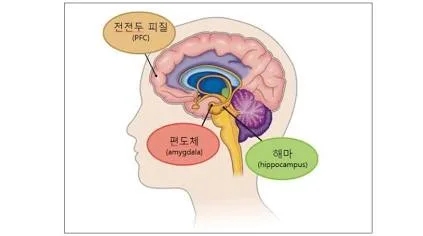
Our brain, and especially the amygdala, which handles primitive emotions, can’t perfectly tell verbal imagination from reality.
The moment a thought like “I’m a failure” pops into your head, if you and the thought are fused, the amygdala perceives it not as a mere idea but as “a real emergency.” As a result, the autonomic nervous system is stimulated, and the stress hormones cortisol and adrenaline pour into the bloodstream.
Cognitive fusion: thought = reality The thought “I think I’ll fail” turns straight into the conviction “I’m done for,” paralyzing the rational judgment of the frontal lobe.
Cognitive defusion: thought ≠ reality You observe, “My brain is producing the thought ‘I think I’ll fail’ right now,” creating distance between the thought and your self.
3. The neuroscience of cognitive defusion: the prefrontal cortex and the amygdala compete for control
According to research in the Journal of Consulting and Clinical Psychology and neuroimaging (fMRI) studies, remarkable neurological changes take place inside the brain when cognitive defusion skills are applied.
When we begin to observe our thoughts objectively, the dorsolateral prefrontal cortex (dlPFC), responsible for higher cognition, and higher-order cognitive circuits switch on immediately. As the prefrontal cortex takes control, it sends inhibitory signals down to the amygdala, calmly quieting the emergency alarm of the overactivated emotional brain.
| Forcing positive thinking (suppression) | Cognitive defusion (observation) | |
|---|---|---|
| Brain energy | High (more mental fatigue) | Minimal (efficient use of energy) |
| Circuits at work | Cognitive overload and a draining tug-of-war | The prefrontal cortex reins in the amygdala; calm mode |
| Result | Rebound effect; anxiety returns | Stabilized, more flexible neural circuits |
4. Three defusion switches for watching the clouds in your head
Following the principle of neuroplasticity, if you keep training the habit of cognitive defusion, the brain builds resilient neural circuits that don’t immediately run wild when anxious stimuli come in.
Label your thoughts
Instead of thinking “I’m incompetent,” rephrase it and say it out loud: “My brain is having the thought ‘I’m incompetent’ right now.” A clear observer zone forms between you and the thought.
Name your thoughts, and thank them
When a pessimistic thought pops up out of nowhere, lightly reply: “Oh, my brain’s ‘safety alarm team’ is working to protect me again. Thanks, but I’m okay right now.”
Watch the popcorn in your mind
Watch the thoughts in your head like popcorn popping, or clouds drifting across the sky. Even if you don’t grab hold of a cloud or try to clear it away, every thought fades on its own after a while, biologically speaking.
We are not “the thoughts themselves” that we have, but the “vast observer” (self-as-context) who can quietly watch those thoughts. The moment you separate yourself from the noisy chatter in your head, your brain at last finds true rest and freedom.
5. Closing
When I forced myself to “think positive,” I felt resistance rise inside me. But simply naming the thought, “Ah, my brain is sounding the alarm again,” noticeably eased the tightness in my chest.
Anxiety is not an enemy that has to disappear. Even with fear riding along as an uninvited passenger, we can still turn the wheel toward the life we want. Tonight, try gently setting the thoughts drifting in your mind down on a sheet of paper.
References
- Hayes, S. C., et al. (2006). Acceptance and Commitment Therapy: Model, processes and outcomes. Behaviour Research and Therapy, 44(1), 1–25.
- Dimidjian, S., et al. (2016). Neural correlates of cognitive defusion in mindfulness-based interventions. Frontiers in Human Neuroscience, 10, 520.
- Journal of Consulting and Clinical Psychology (2018). Mechanisms of Change in ACT: Cognitive Defusion and Amygdala Reactivity. APA Review.
This post is health and science information based on recognized research in cognitive psychology and neuroscience journals, and it cannot replace professional psychiatric diagnosis or treatment.
Was this article helpful?
Your choice is saved only in this browser and is never sent anywhere.