You stopped at last time.
The story in four panels
Guard the gut's IgA, guard the brain
-
1The problem
A tired person with a lowered head beside an almost empty battery I only cared about my brain…
To grow the brain, is it enough to look after your head? The starting point may be the gut.
-
2How it works
The brain and the gut joined by a dotted line Gut and brain are linked
The gut-brain axis: gut and brain trade signals in real time through the vagus nerve and the immune system.
-
3What to do
A shield with a check mark keeping germs away The IgA firewall
IgA antibodies are the gut lining's first line of defense, and they protect the brain in the meninges too.
-
4The change
A sprout growing from the top of a brain Healthy gut, healthy brain
Gut care carries through to serotonin, BDNF and neuroplasticity.
💡 Three key takeaways
- The gut-brain axis: the gut and the brain are linked by fine neural circuits that exchange signals in real time through the vagus nerve and the immune system.
- IgA antibodies and the intestinal barrier: when immunoglobulin A (IgA), which guards the gut lining, breaks down, toxins and harmful bacteria ride the bloodstream across the blood-brain barrier (BBB) and trigger inflammation in the brain.
- Brain development and gut care: tidying the gut ecosystem with probiotics and prebiotics is the fastest way to maximize the brain’s cognitive ability and neuroplasticity.
Introduction: if you want to develop your brain, why start with the gut?
When we want clear thinking, strong focus, and healthy emotional regulation, we usually focus only on the head (the brain). But the latest research in neuroscience and gastroenterology has made it clear that “the switch for brain health and development lies not in the head but in the gut.”
In his book Brain Maker, world-renowned neurologist Dr. David Perlmutter laid out the mechanisms linking immunoglobulin A (IgA), the key immune substance that guards the gut lining, with the gut-brain axis. To support brain development and prevent cognitive decline, protecting IgA, the sentinel of the gut’s immune system, is essential.
The triangle of IgA antibodies, the gut lining, and brain health
1. IgA antibodies and the “brain-gut firewall” in the meninges
The gut is the body’s largest immune organ, home to more than 70% of the body’s immune cells. Among them, immunoglobulin A (IgA) is the most important antibody secreted by the cells lining the gut.
- The gut lining’s first line of defense: IgA acts as the first barrier, keeping viruses, pathogenic bacteria, and toxins in the gut from getting through the intestinal wall.
- IgA cells stationed in the meninges: according to recent findings in neuroscience, including joint research by the University of Cambridge and the U.S. National Institutes of Health (NIH), IgA-secreting plasma cells trained in the gut through interactions with beneficial bacteria travel through the bloodstream and settle beside the large blood vessels of the meninges, the membranes surrounding the brain.
- The gut-brain firewall at work: these cells act as a guard force in the bloodstream, defending the brain in real time so that microbes and toxins can’t invade the central nervous system (CNS). When gut health collapses, this firewall weakens too, leaving the brain defenseless against infection and chronic inflammation.
2. Three mechanisms that shape brain development and neuroplasticity
From birth through infancy and adolescence, the development of gut microbes and the immune system proceeds in precise parallel with the formation of the brain’s physical structure.
- Guiding brain cell development and myelination: in experiments with “germ-free mice” lacking gut microbes, animals without a gut ecosystem developed lasting abnormalities in neurogenesis, in myelination (the insulation that protects neurons), and in the stress-regulation axis (the HPA axis), leading to anxiety and poorer memory.
- Regulating microglia: short-chain fatty acids (SCFAs), produced when beneficial gut bacteria break down dietary fiber, help microglia, the brain’s immune cells, mature and function normally. Because microglia prune unnecessary synapses during brain development, gut health effectively determines how precisely brain circuits are formed.
- The birthplace of neurotransmitters: about 90% of serotonin, which plays a decisive role in emotion and cognition, is produced in the gut in response to gut microbes. When the gut environment deteriorates, it can negatively affect mental and cognitive development, contributing to anxiety, depression, and attention problems.
3. How leaky gut syndrome creates brain fog
When IgA secretion drops and the gut microbiome falls out of balance, tiny cracks form in the intestinal wall: leaky gut syndrome.
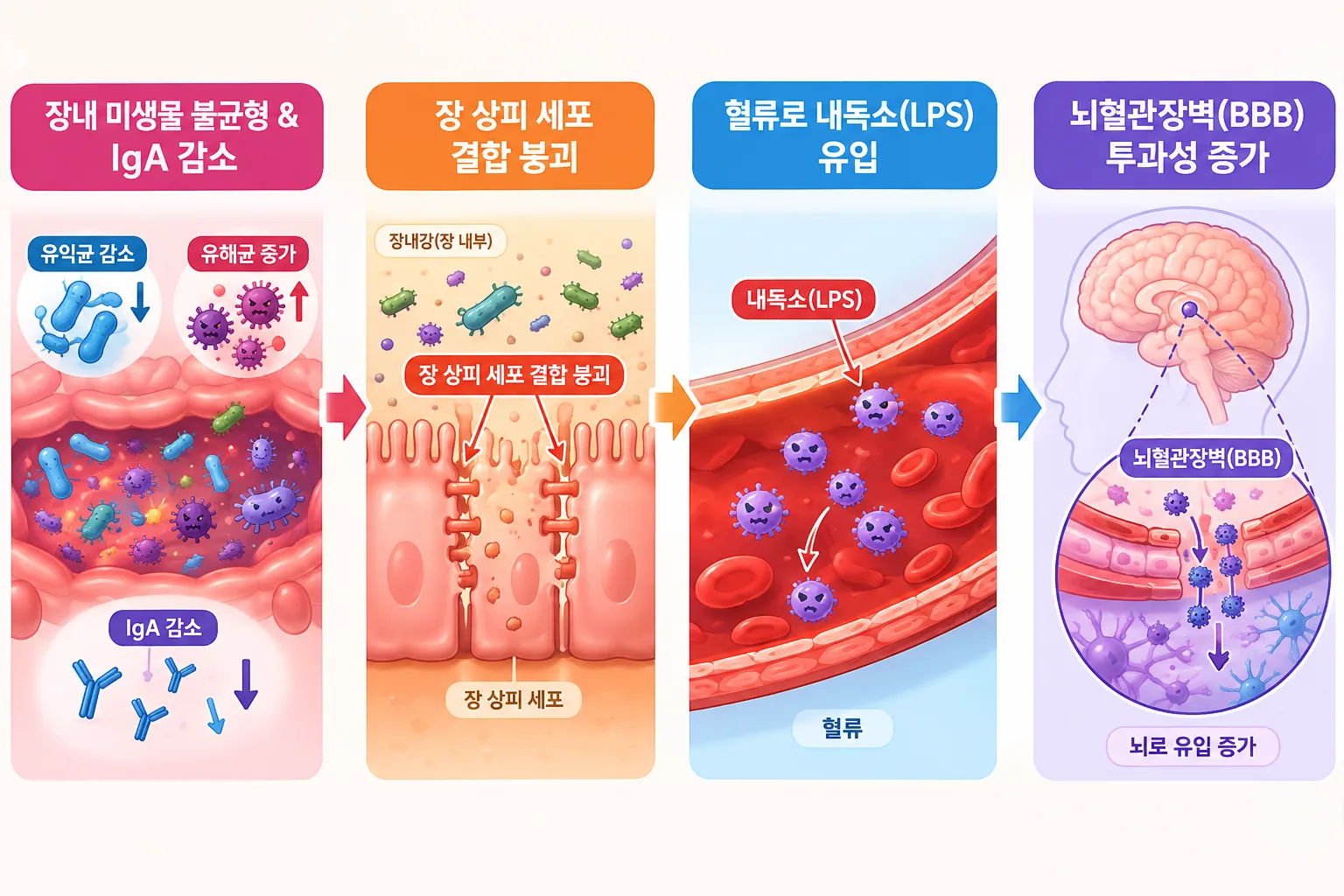 Diagram of the tiny openings in the arachnoid that drain cerebrospinal fluid and of meningeal lymphatic vessels that remove waste
- Endotoxins (LPS) enter the bloodstream: endotoxins and byproducts of harmful bacteria that slip through the intestinal wall into blood vessels travel throughout the body.
- Damage to the blood-brain barrier and overactive microglia: toxins in the blood make the blood-brain barrier (BBB) that protects the brain more permeable and overstimulate microglia, setting off neuroinflammation.
- More interleukins and inflammatory cytokines: the chronic brain inflammation that results leads to poor concentration, brain fog, chronic fatigue, and even low mood and long-term cognitive decline.
4. Seven integrated gut-care strategies for brain development and optimization
Brain development, deep focus, and a clear mind begin with careful gut care. When diet and lifestyle mesh like gears, IgA antibodies in the gut lining are protected and brain inflammation is shut down.
Part 1. Three tailored diet strategies
① A balanced, plant-rich diet
This strategy maximizes the diversity of the gut ecosystem by eating complex carbohydrates, plant and animal proteins, and quality fats in balance.
- A surge of short-chain fatty acids from soluble fiber: soluble fiber from whole grains, vegetables, and fruit feeds beneficial gut bacteria, which produce large amounts of SCFAs such as butyrate. These fuel the cells lining the gut and stimulate the vagus nerve, promoting the expression of BDNF. (Evidence: Koh et al., Cell, 2016)
- Activating gut-lining immunity (IgA) with fermented foods: lactic acid bacteria in plant and animal fermented foods stimulate the gut’s lining cells, promoting the production of secretory IgA (sIgA), the first-line defensive antibody, and blocking the invasion of harmful bacteria. (Evidence: Waki et al., Microbiology and Immunology, 2014)
- Protecting tight junctions by cooking out antinutrients (lectins, oxalates): removing the lectins and other antinutrients in legumes and whole grains by soaking, cooking thoroughly, and fermenting helps prevent damage to the junctions between gut cells and leaky gut. (Evidence: Vasconcelos & Oliveira, Toxicon, 2004)
🥗 Recommended foods
- Fermented foods for gut-lining immunity: unpasteurized kimchi, sauerkraut, natto, plain yogurt, miso (doenjang)
- Prebiotics (complex carbohydrates): oats, Jerusalem artichoke, chicory root, cooked asparagus, bananas
- Quality protein and fat: lean meat, eggs, salmon, perilla oil, extra-virgin olive oil
② A carnivore diet
This strategy minimizes irritation of the gut lining by cutting out plant irritants entirely and regenerating cells directly.
- Fully protecting tight junctions by cutting out antinutrients: completely eliminating plant lectins and oxalates reduces mechanical irritation of the gut lining and suppresses the release of the protein zonulin, blocking leaky gut at the source. (Evidence: Fasano, A., Physiological Reviews, 2011)
- Keeping the gut clean through stomach acid and bile acids: protein- and fat-centered meals promote the secretion of stomach acid and bile acids, preventing small intestinal bacterial overgrowth (SIBO) and creating a clean gut environment in which IgA can work smoothly. (Evidence: Ridlon et al., Journal of Lipid Research, 2006)
- Directly regenerating the gut lining with key amino acids (glutamine, glycine): L-glutamine and glycine from bone broth and meat serve as a direct energy source for the gut’s lining cells, maintaining the thickness of the lining and regenerating the intestinal barrier. (Evidence: Wang et al., Amino Acids, 2015)
🥩 Recommended foods
- Broths that regenerate the gut lining: bone broth, oxtail soup (rich in glutamine and collagen)
- Main protein and fat: grass-fed beef, lamb, beef liver (contains vitamin A and copper)
- Support for stomach acid and bile: sea salt (supplies the chloride needed to make stomach acid), ghee
③ A ketogenic (low-carb, high-fat) diet
This strategy reduces brain inflammation and tidies the gut ecosystem through ketone bodies produced by fat metabolism.
- Directly blocking brain inflammation (microglia) with ketones (BHB): beta-hydroxybutyrate (BHB), produced by fat metabolism, directly suppresses the NLRP3 inflammasome in the brain, breaking the vicious cycle of brain inflammation caused by endotoxins (LPS) entering through a leaky gut. (Evidence: Youm et al., Nature Medicine, 2015)
- Protecting the gut’s mucin layer with healthy fats: MCT oil and the oleic acid in olive oil help beneficial bacteria (Akkermansia muciniphila) that protect the gut lining multiply, strengthening the gut-lining ecosystem and IgA responsiveness. (Evidence: Rouxinol-Dias et al., Nutrients, 2021)
- Preventing BBB permeability by blocking advanced glycation end products (AGEs): limiting refined sugar reduces blood sugar swings and blocks the formation of AGEs, protecting the blood-brain barrier and preventing brain fog. (Evidence: Ma et al., Frontiers in Aging Neuroscience, 2018)
🥑 Recommended foods
- Quality healthy fats: avocado, extra-virgin olive oil, MCT oil, coconut oil
- Low-carb food for beneficial gut bacteria: sauerkraut, olives, spinach, asparagus
- Fatty proteins: salmon, mackerel (rich in omega-3s), pasture-raised eggs, grass-fed butter
Part 2. Four synergistic lifestyle strategies
Just as much as diet, daily rhythm and physical activity are powerful switches that activate the gut-brain axis.
④ Optimize sleep and your circadian rhythm
- The gut’s own body clock: gut microbes and the cells lining the gut also regulate immune substances and hormones according to the sleep-wake cycle.
- Lack of sleep and leaky gut: without enough sleep, the gut lining’s defenses weaken sharply, IgA secretion drops, and endotoxins enter the bloodstream, causing brain fog.
- Tip: keep a regular routine of going to sleep and waking up at the same time every day.
⑤ Aerobic and strength exercise (boosting neuroplasticity)
- More diverse beneficial bacteria: exercise at the right intensity improves blood flow to the gut and raises the proportion of beneficial bacteria that make short-chain fatty acids by more than 40%.
- Activating BDNF: signaling substances released by muscles and the gut during exercise travel to the brain through the vagus nerve, maximizing the formation and plasticity of neurons.
- Tip: combine light jogging, interval training, and strength training for at least 30 minutes, three to five times a week.
⑥ Get sunlight (vitamin D and serotonin)
- Strengthening gut-lining immunity (IgA): vitamin D made from sunlight firms up the tight junctions between the cells lining the gut, directly blocking leaky gut.
- Promoting serotonin: sunlight entering through the eyes and skin helps serotonin production in cooperation with gut microbes, and at night serotonin is converted into melatonin, inducing deep sleep.
- Tip: spend about 20 to 30 minutes outdoors in the sun each day, between 10 a.m. and 2 p.m.
⑦ Breathing and vagus nerve stimulation
- The direct link between breathing and the vagus nerve: deep, slow belly breathing directly stimulates the vagus nerve, the pathway connecting brain and gut, activating the parasympathetic nervous system.
- Blocking chronic stress and the collapse of the intestinal barrier: breathing control alone can quickly ease the loss of beneficial gut bacteria and the suppression of IgA caused by excess stress hormone (cortisol).
- Key breathing tip: practicing “4-6 belly breathing” (a 4-second inhale and a 6-second exhale), with the exhale longer than the inhale, for 5 minutes a day calms inflammatory signals in the brain and helps it recover from fatigue.
Conclusion: the best way to unlock the brain’s potential is gut immunity
The food we eat changes the gut’s microbial ecosystem, and the short-chain fatty acids (SCFAs) and IgA these microbes produce regulate the production of the brain’s neurotransmitters (serotonin, GABA, and others).
Effort spent simply taking in knowledge can’t develop a clear brain on its own. Eating and living in ways that protect IgA in the gut lining and keep the gut-brain axis clean is the most powerful, scientific approach to bringing out the brain’s peak performance.
Whether you choose a balanced diet, a carnivore diet, or a ketogenic diet, the core is the same: guard the gut lining’s immunity (IgA) to keep toxins from flowing into the bloodstream, and protect the blood-brain barrier (BBB) to shut down brain inflammation.
Using the scientific principles and food lists introduced today, start a gut-care diet that fits your own lifestyle. You may find the brain fog weighing on your head lifting, and your brain’s potential rising to its peak.
References
- Perlmutter, D. (2015). Brain Maker: The Power of Gut Microbes to Heal and Protect Your Brain–for Life. Little, Brown and Company.
- Mayer, E. A. (2016). The Mind-Gut Connection: How the Hidden Conversation Within Our Bodies Impacts Our Mood, Our Choices, and Our Overall Health. Harper Wave.
- Frontiers in Immunology (2020). Secretory IgA and the Gut-Brain Axis: Implications for Neuroinflammation and Cognitive Health.
This post is health information based on recognized neuroscience and gastroenterology journals and books, and it cannot replace professional medical diagnosis or treatment.
Was this article helpful?
Your choice is saved only in this browser and is never sent anywhere.