You stopped at last time.
The story in four panels
Giving up isn't a willpower problem
-
1The problem
A plate with meat, an egg, and greens, with a fork and knife A late-night snack, again…
Diets and put-off tasks keep slipping, and you end up blaming yourself.
-
2How it works
A tired person with a lowered head beside an almost empty battery A brain that saves energy
The brain is 2% of body weight but uses 20% of its energy, so it always chooses to save.
-
3What to do
A staircase climbed step by step with a flag at the top Lower the starting barrier
Make the first step tiny and move right away with the five-second rule.
-
4The change
A brain with an even wave and a slowly beating heart A smile instead of blame
Managing the brain's energy itself changes your choices.
You’re on a diet, and you ordered a late-night snack again anyway. The task you put off until tomorrow is still sitting there today. Have you ever blamed yourself, wondering why your willpower is so weak? In fact, these repeated choices are most likely not a willpower problem.
It wasn’t weak willpower; your brain was fooling you to save energy.
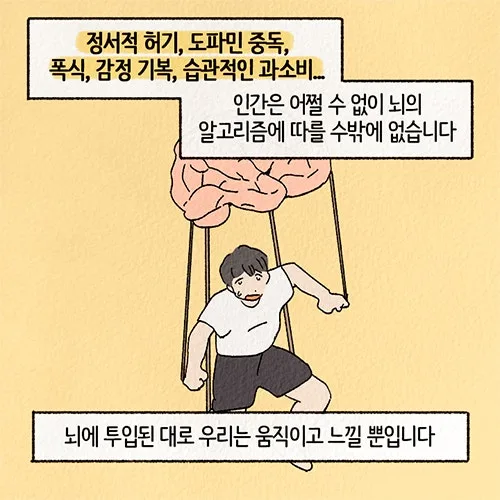 Source: I Read Brain Science Because I Want to Live as Myself
The brain accounts for only about 2% of body weight, yet it’s an organ that consumes nearly 20% of all the energy the body uses on its own. That’s why, for the brain, saving energy is a matter of survival. So the brain avoids new decisions, complex thinking and unfamiliar challenges whenever it can, quietly nudging us toward the familiar and comfortable.
The problem is that this happens without our noticing. We believe we chose rationally, but often the brain has already set the direction toward whatever costs less energy and tacks on a plausible reason afterward. Today let’s look, one by one, at how the brain’s energy-saving habit shapes our choices and regrets.
The brain is 2% of the body but uses 20% of the energy
The brain uses so much energy because every neuron is constantly sending and receiving signals. Thinking, remembering and feeling are all electrical signals fueled by glucose. That’s why the brain is sometimes called the most expensive organ in the body.
Because humans survived for ages in environments where food was scarce, the brain evolved to save energy. Individuals who saved energy efficiently had a survival advantage over those who spent it needlessly. Even though we now live without worrying about food, this ancient thrifty habit of the brain remains intact.
The moment you feel “can’t be bothered,” the brain has already done the math
Some days your body feels heavy when you should go work out, or you just can’t focus when you should start studying. At those moments, the brain is weighing in an instant how much energy the action requires and how big the reward is in comparison. Psychology describes this as weighing effort against reward.
The problem is that this weighing is heavily biased in the brain’s favor. With things like exercise or study, whose results show up later, the energy cost is immediate while the reward feels distant, so the brain calculates them as a loss. By contrast, looking at your phone or eating a late-night snack costs little energy and rewards you immediately, so the brain picks them easily.
In the end, the moment you feel “I really don’t want to do it today” is closer to the result of the brain having already finished a cost-benefit calculation than to an emotion. That’s why trying to suppress it with willpower feels like a losing battle.
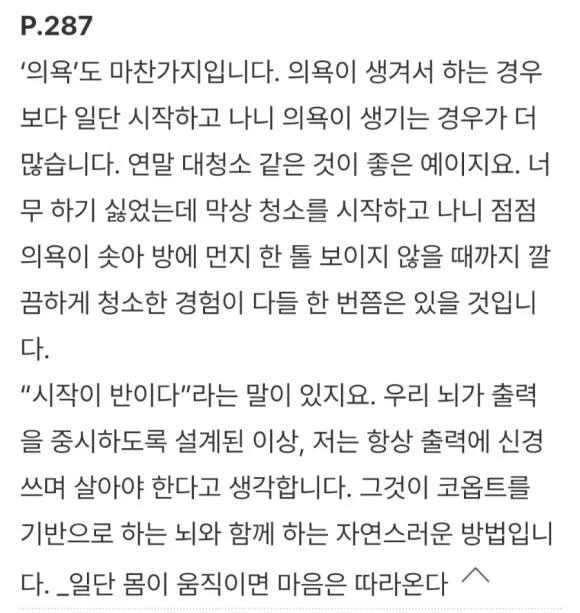 Source: I Read Brain Science Because I Want to Live as Myself
It’s not weak willpower; the brain simply chose efficiency
At one time, the view that willpower is a resource that gets used up the more you use it, like a muscle, was widespread. By this view, if you hold out all day, your willpower runs dry by evening and you eventually crumble. Indeed, many people experience their diet falling apart in the evening or giving up on something they’d been resisting.
Recently, however, another view has been gaining ground: that this isn’t simple willpower depletion, but the brain switching to easier options to reduce the fatigue that builds up from making many decisions all day. In other words, it’s less that willpower disappears and more that the brain pulls down the shutters on its own to conserve resources.
So failing to resist a late-night snack, or putting off a task yet again, isn’t a matter of character or grit. It’s most likely the brain’s natural response, trying to save its remaining energy after a day’s worth of big and small decisions has piled up.
Why does regret always come later?
When the brain makes an energy-saving choice, it factors in only the comfort right in front of it. What that choice will lead to in a few days or weeks isn’t weighed much in that moment’s calculation. So you feel comfortable at the moment of choosing, and regret only floods in later, when you see you’ve drifted from your goal.
It’s easiest to understand as two systems in the brain working differently. A system that seeks immediate comfort and a system that calculates long-term goals run separately and clash. Because the immediate, energy-saving system generally reacts first and more strongly, the side in charge of long-term goals sends its signal, regret, only belatedly.
Once you understand this structure, instead of beating yourself up every time you feel regret, you can change your environment so the brain can make good choices while using less energy in the first place.
How to turn the brain’s thrifty instinct to your advantage
“You don’t act because you feel motivated. Only when you move your body first does the brain pump out motivation.”
The first thing you can do is reduce the number of decisions. Instead of debating whether to exercise every day, decide in advance that you’ll do it at a set time no matter what, which cuts out the brain’s cost-benefit calculation each time. Fewer decisions mean less energy spent, leaving the brain less room to resist.
The second is lowering the energy barrier at the starting line as far as possible. Make the first move tiny, such as laying out your workout clothes in advance or opening a book and reading just the first page, and the brain judges that it won’t cost much energy and starts without resistance. Once you’ve started, momentum builds and continuing becomes much easier.
The third is managing the energy available to the brain itself. On days when you’re short on sleep or your blood sugar swings, the brain tires more easily than usual and leans more readily toward the easy choice. Simply getting enough sleep and eating regular meals noticeably reduces the moments when the brain strains to save energy.
The fourth is using the five-second rule to stimulate the nucleus accumbens. The nucleus accumbens (reward circuit), the brain region in charge of motivation, never activates from thinking alone. Only once physical movement (output) begins does it release dopamine and create motivation. When there’s something you don’t want to do (studying, exercising, cleaning), set your feelings aside, count “5, 4, 3, 2, 1” and move your body for three minutes first.
The fifth is practicing smiling. When you feel down, fool your brain by lifting the corners of your mouth, even artificially, and holding it for at least 15 seconds. For example, if you’re a little short on sleep today, instead of saying the moment you get up, “This is going to be a long day,” smile and fool your brain: “I slept well. It’s sunny today, and I think something good will happen.”
Starting today, try this instead of blaming yourself
When you’ve put something off again or failed to resist something you meant to resist, if your first thought is “What’s wrong with me?”, you can now look at it a little differently. That moment most likely wasn’t a lack of willpower but the result of the brain picking the easiest option to save energy.
Of course, that doesn’t mean you should blame every choice on your brain and give up. But rather than berating yourself, designing your environment and habits so the brain moves in a good direction while still saving energy is a far more realistic and sustainable approach. Simply lowering small barriers, cutting down on decisions and keeping your body’s energy well topped up can noticeably reduce how often you make choices you’ll regret.
If you’ve been beating yourself up over willpower, save this post about the brain’s energy-saving habit or share it with someone wrestling with the same thing.
Was this article helpful?
Your choice is saved only in this browser and is never sent anywhere.