You stopped at last time.
The story in four panels
Was muscle behind weak willpower?
-
1The problem
A tired person with a lowered head beside an almost empty battery I just lack willpower…
I believed exercise was for the body and books were for the brain.
-
2How it works
A sprout growing from the top of a brain Signals from muscle
Muscles release myokines that lower inflammation and slow brain aging.
-
3What to do
A person lifting a barbell Aerobic + strength
Running supports the hippocampus and BDNF; lifting supports the prefrontal cortex. Do both.
-
4The change
A light bulb glowing above a person deep in thought Stronger willpower
The brain function closest to willpower grows stronger, and crystallized intelligence is protected.
When I first heard that lifting heavy barbells at the gym is good for the brain, I was honestly skeptical. I had vaguely believed that exercise was for the body, and that to use your head you had to read books. But my own experience told a different story. After I started adding weight training consistently, my focus changed noticeably, and while digging into why, I came across studies on how strength training affects the brain.
Why running alone wasn’t enough: strength training works on the brain differently
At first, I also thought aerobic exercise was all there was to brain health. I ran for 30 minutes every morning and considered that enough. Aerobic exercise does trigger the release of BDNF (brain-derived neurotrophic factor), which helps new neurons grow. BDNF is a protein that grows and maintains neurons in the brain, and it plays a key role in increasing the volume of the hippocampus, the region responsible for memory. That is said to be why memory and overall cognitive function improve.
But even after running consistently for nearly a year, the ability I needed most, the strength to resist impulses and push a plan through to the end, didn’t change much. This is closely tied to executive function. Executive function is a capacity governed by the prefrontal cortex: it suppresses immediate urges and coordinates behavior toward a goal. Put simply, it is the brain function closest to “willpower.” Studies have repeatedly found that what most strongly boosts executive function is not aerobic exercise but strength training (Source: PubMed Central — Resistance Training and Cognitive Function).
There’s one more thing: strength training stimulates the release of IGF-1 (insulin-like growth factor 1). IGF-1 is a hormone the body releases into the bloodstream in response to muscle contraction. It crosses the blood-brain barrier and reaches the brain directly, helping damaged nerve tissue recover and helping maintain neuroplasticity. If BDNF’s role is to grow new brain cells, IGF-1’s role is closer to repairing existing brain cells so they don’t break down. It was only after learning this that I began to think the clearer head I felt after starting weight training might not just be in my mind.
- Aerobic exercise → BDNF release → larger hippocampus → better memory and learning
- Strength training → IGF-1 release → nerve tissue repair and maintained neuroplasticity
- Strength training → prefrontal cortex activation → better executive function (impulse control, following through on plans)
In short: strength training strengthens the brain by a different route than aerobic exercise, raising executive function and neural resilience through IGF-1 release and prefrontal activation.
The brain wastes away like muscle: how myokines slow brain aging
In my experience, this one is a little different. I had dismissed my blurrier memory as simply a matter of “aging,” but it turned out to be directly linked to muscle loss. From around age 35, the brain gradually begins to lose volume, and connections between neurons slowly break. Recent studies show that muscle condition is a barometer of overall health, to the point that grip strength and muscle mass are used as indicators that predict mortality (Source: WHO — Dementia Fact Sheet).
The key is myokines. Myokines are signaling molecules released by muscle cells themselves when muscles contract. They travel through the bloodstream to the brain and help lower chronic inflammation. Why does chronic inflammation matter? Because researchers have recently been reframing many mental illnesses, including depression and bipolar disorder, as “inflammatory brain conditions.” When I first came across this, it felt unfamiliar, but I nodded along when I remembered how, during low periods, my whole body felt heavy, almost like an inflammatory response.
If the brain were an old apartment building, aging would be the cracks in the walls, and substances like myokines and IGF-1 would be the repair crew that fills and fixes them. Neglecting strength training is like letting the repair crew go, and cognitive decline inevitably speeds up. From your 40s on, the repair crew’s role becomes much bigger, which helps explain why the effects of strength training are more pronounced in middle age.
If the gym strengthens the brain’s hardware, books and learning fill in the software. The hardware here is fluid intelligence: the ability to respond to new problems on the spot and improvise solutions. Crystallized intelligence, by contrast, is the sum of the knowledge and experience built up over a lifetime. When I combined the two, I found that what I read sank in much better after a workout. Better hardware really does make the software run better, and you can feel it.
In short: myokines released during muscle work lower chronic inflammation in the brain, acting as a core mechanism by which strength training slows brain aging and cognitive decline.
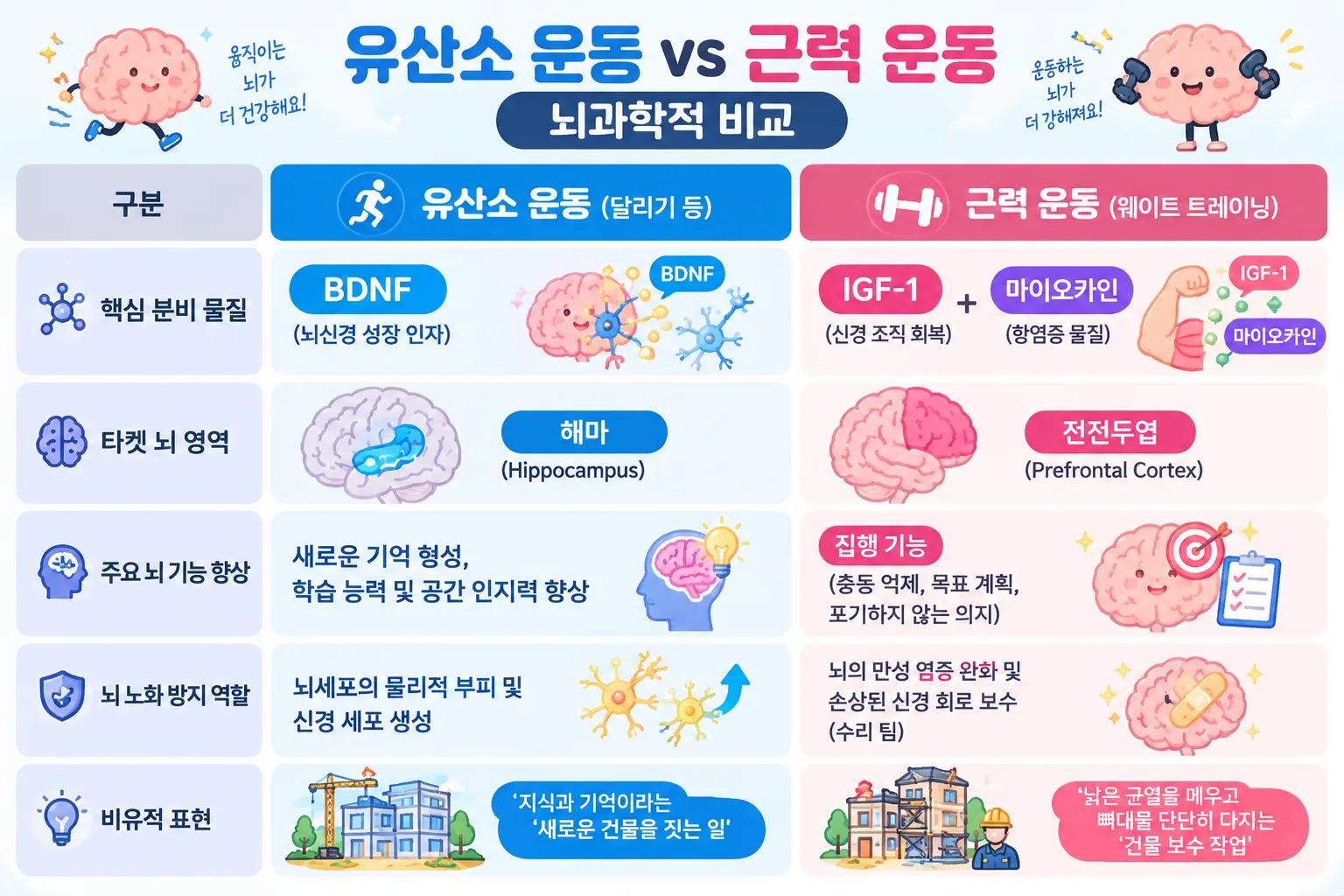 Comparing how aerobic exercise and strength training each benefit the brain
Frequently asked questions
How much strength training does it take to affect the brain?
In my own experience, I noticed a change in focus about four to six weeks after starting consistent weight training two to three times a week, 40 to 50 minutes per session. Studies also report meaningful improvements in executive function when resistance training is done at least twice a week for eight weeks or more. That said, I think consistency comes before intensity.
Can I do only strength training instead of aerobic exercise?
Because the two act on the brain through different pathways, combining them is far more effective than substituting one for the other. Aerobic exercise grows the hippocampus through BDNF, while strength training repairs the brain and strengthens executive function through IGF-1 and myokines. I split my week into about two aerobic sessions and three weight sessions, and this combination has felt the most effective for me.
I’m on the older side. Will strength training still help if I start now?
Research consistently concludes that the effects are actually greater with age. From your 40s onward, the brain-protective effects of myokines released by muscle become all the more important. Of course, it’s important to start with light weights and slow movements so you don’t strain your joints.
Does strength training actually help with depression?
Personally, during periods when I felt low, I noticed a clear change in mood after weight training. In research, there is a growing view of depression as part of an inflammatory response in the brain, and the anti-inflammatory action of myokines acts directly on this mechanism. That said, if your symptoms are serious, it’s right to combine exercise with professional help.
Conclusion
To sum up, if you want to use your brain well for a long time, relying on aerobic exercise alone is like turning only one wheel. Strength training does three things at once: it repairs the brain through IGF-1 and myokines, it trains the prefrontal cortex to raise the executive function that suppresses impulses and carries out plans, and it lowers chronic inflammation, improving mental health as well.
What changed most after I began consistently adding weight training wasn’t focus but “the strength not to give up.” Only later did I learn that this was a change in executive function that comes from a stronger prefrontal cortex. If you’re in your 40s or beyond, I think opening the gym door right now could be the best investment you make in your brain.
Reference: https://www.youtube.com/watch?v=FdpZLVsyBUo
Was this article helpful?
Your choice is saved only in this browser and is never sent anywhere.