You stopped at last time.
The story in four panels
The brain needs a switch, not persuasion
-
1The problem
A tired person with a lowered head beside an almost empty battery Pull yourself together…
No matter how often I repeated my resolutions, the burnout didn't lift.
-
2How it works
Two neurons reaching out and connecting What green algae taught us
Optogenetics: shine light on channelrhodopsin and a brain circuit switches on.
-
3What to do
A light bulb glowing above a person deep in thought 30 seconds of visualization
Wellness routines like 30 seconds of visualization before exercise act directly on brain circuits.
-
4The change
A brain with an even wave and a slowly beating heart A switch, not persuasion
Actions that switch on the reward circuit come before resolutions.
At the height of my burnout, I told myself every morning, “Today I’ll pull myself together.” But no matter how many times I resolved to, nothing changed. The brain science I stumbled into at that time ended up changing the way I live. On October 5, 2026, the Nobel Prize in Physiology or Medicine went to optogenetics, “the technology of switching brain cells on and off with light.” It was the moment science formally confirmed what I had first felt through experience.
Channelrhodopsin: a neuroscience revolution that began with green algae
Honestly, this surprised me: the clue that shook up neuroscience came from single-celled green algae living in ponds.
These algae have a protein called channelrhodopsin. Channelrhodopsin is a light-sensing protein that, when it detects light of a specific wavelength, opens ion channels in the cell membrane, lets ions such as sodium pass through, and generates an electrical signal. A survival device for swimming toward light became a key to human neuroscience.
The 2026 Nobel laureates in Physiology or Medicine, Karl Deisseroth, Peter Hegemann, and Georg Nagel, succeeded in inserting the channelrhodopsin gene into neurons in the brain (Source: Chosun Ilbo, Oct. 6, 2026). This made it possible to shine light at a chosen moment and switch on or off only specific brain cells.
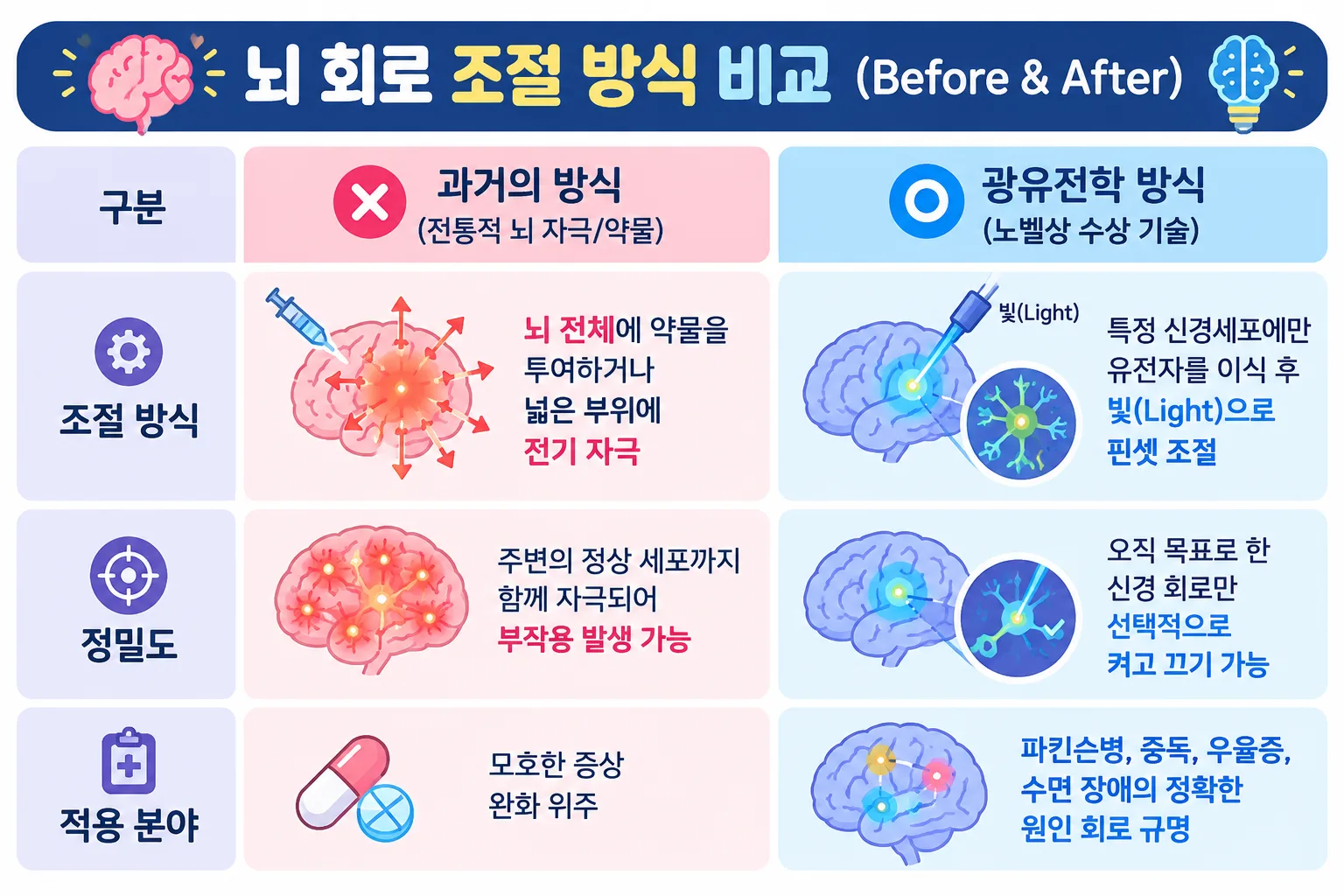
When I first came across this idea, the image that came to mind was an old fuse box. If earlier brain research was like flipping the main breaker off and on and guessing which room had the problem, optogenetics is like picking out exactly one of hundreds of millions of switches, attaching a wireless remote to the desk lamp in the study alone and turning just that light on and off precisely. Researchers who for decades had to deal with “the whole brain” could at last pick out a single neural circuit with tweezers.
In short: the core of optogenetics is inserting channelrhodopsin, a light-sensing protein from green algae, into neurons so that light can precisely switch specific brain cells on and off.
When the map of brain circuits changes, so does the precision of treatment
If optogenetics had stayed a lab technique, it wouldn’t have drawn this much attention. Over the past twenty years or so, it has become a key tool for decoding the brain circuits that govern our lives: memory, sleep, depression, addiction, appetite, movement, and more.
Deep brain stimulation (DBS), used to treat Parkinson’s disease, is a prime example. DBS is a procedure in which electrodes are implanted deep in the brain to send electrical signals that ease movement disorders. The problem was that it had been hard to know exactly which cell circuits DBS should stimulate. Thanks to optogenetics, the brain circuits behind movement disorders can now be identified far more precisely, and this is laying the groundwork for more accurate DBS.
At first, the idea of brain circuits felt vague to me too. Then a metaphor made it click. Our nervous system is like a huge orchestra. Countless instruments play at the same time, and without a conductor, each section loses the beat and creates dissonance. A brain circuit working properly means each section is playing its own melody exactly right. Optogenetics is the tool that, for the first time, let us read that score properly.
What I felt as I slowly recovered from burnout was similar. It wasn’t willpower or resolutions; things only changed when I changed my environment so my brain could physically find its rhythm again. It struck me that what optogenetics research has revealed and my own experience touch each other in a strange way.
- Parkinson’s disease: precisely identifying the circuits behind movement disorders helps advance deep brain stimulation (DBS)
- Severe depression: finding where emotion-regulation circuits malfunction clarifies treatment targets
- Sleep disorders: revealing how the neural circuits that switch between wakefulness and sleep work
- Addiction: separating the roles of specific neurons within the reward circuit and exploring ways to intervene
In short: optogenetics is laying the groundwork for a leap in treatment precision by pinpointing the exact circuits behind major brain conditions such as Parkinson’s disease, depression, and sleep disorders.
Wellness routines were actually acting directly on brain circuits
The first thing I changed after burnout was my morning routine. Before my coffee, I would step outside and get about 20 minutes of sunlight. At first I thought of it as little more than a mood boost. Only later did I learn that it was doing something precise, in brain-science terms.
Inside the eye are intrinsically photosensitive retinal ganglion cells (ipRGCs). ipRGCs are dedicated light-sensing cells in the retina that convey not visual information but the brightness and wavelength of light directly to the brain’s body clock. When morning daylight stimulates these cells, the brain’s arousal circuits switch on and the release of dopamine and serotonin is promoted. Just as Nobel-winning optogenetics switches on specific neurons with a laser, morning sunlight naturally flips the brain’s circadian switch through the ipRGCs.
The second thing I tried that had a fairly clear effect was “30 seconds of visualization” before exercise: before actually moving, you vividly imagine the sensation of the muscles you’re about to contract. It works because the brain’s motor cortex, the region that commands body movement, is already set up before the actual movement. After adding this routine to my regular weight training, my focus and my sense of connection to the muscle clearly changed.
The third is mineral supplementation. When channelrhodopsin receives light and opens its ion channel, sodium flows into the cell and an electrical signal is generated. For this ion exchange to work properly, it has to be supported by magnesium and a balance of electrolytes such as sodium and potassium in the body. After learning that magnesium plays a key role in keeping the membrane potential, the electrical difference between the inside and outside of a cell, stable, I added electrolyte supplementation to my routine. My sense of fatigue dropped noticeably.
In short: morning sunlight, visualization before exercise, and mineral supplementation are interventions at the level of brain circuits, acting on ipRGCs, the motor cortex, and membrane potential respectively.
Now I know why “pull yourself together” kept failing
In my experience, this is the different part. Trying to change the brain with willpower is like trying to fix the brain using that very same brain. There’s a concept called neuroplasticity. Neuroplasticity means that the connections between the brain’s neurons can be physically reshaped by experience and environment. The key point is that it is “physical stimulation,” not “thinking,” that changes the brain.
Optogenetics is the technology that tackles exactly this point head-on: switching specific neural circuits on and off directly with a physical stimulus, light. During a period when I was struggling with lethargy and tension, I too spent months trying to change my thinking, only to end up even more exhausted. Seeing the news of this Nobel Prize, I was reminded once again that, in brain-science terms, that failure was entirely to be expected.
Of course, optogenetic treatment isn’t available in hospitals yet. It is currently at the stage of verifying the safety of gene therapy and optical fiber implantation, and research is moving toward refining existing deep brain stimulation (Source: The Nobel Prize official website). But the fact that its principle is already woven into everyday wellness routines is something entirely practical.
The lesson I finally learned is simple: the brain is not something to persuade but something to tune. Set up the circuits first through physical stimulation such as light, movement, and minerals, and thoughts and feelings will follow.
In short: trying to change the brain through willpower has limits; following the principle of neuroplasticity, it is more effective to tune the circuits first with physical stimulation.
Frequently asked questions
Can I get optogenetic treatment at a hospital now?
Not yet; it hasn’t reached clinical use. Research is underway to verify the safety of gene delivery and optical fiber implantation, and rather than serving as a treatment itself, it is used as a key tool for finding the exact circuits behind brain conditions such as Parkinson’s disease and depression, and for refining existing deep brain stimulation (DBS).
Does morning sunlight really affect the brain?
Yes, it’s more than a mood boost. When the retina’s ipRGCs receive daylight, the brain’s body clock and arousal circuits are stimulated directly. Many studies have accumulated showing that 20 to 30 minutes of outdoor morning sunlight affects the release of dopamine and serotonin. In my own experience, this woke me up more reliably than coffee.
Can you explain channelrhodopsin more simply?
It’s a protein that opens a pore in the cell membrane when it receives light, generating an electrical signal. Green algae originally had it to move toward light, and when this gene is planted in brain neurons, a single beam of laser light can activate only the chosen brain cells. It’s a bit like attaching a remote-control receiver to a light bulb socket.
Does visualization before exercise actually work?
In my experience, it clearly made a difference. The brain’s motor cortex has a tendency not to distinguish between real and imagined movements, so simply visualizing the sensation of a muscle contracting in detail before moving activates the neural circuits in advance. For a 30-second investment, the effect I felt was quite large.
Conclusion
The 2026 Nobel Prize in Physiology or Medicine wasn’t just science news to me. It felt as if what I had first discovered with my body, that morning sunlight, visualization, and minerals physically tune the brain’s neural circuits, had been confirmed on the world’s most authoritative stage.
The brain is not something you persuade with willpower. Just as channelrhodopsin opens its ion channel when it receives light, our daily routines are acts that send physical signals to brain circuits. Change your environment before you try to change your thoughts: that is how I got out of burnout, and it is also the principle optogenetics has proven. This morning, I’d encourage you to simply step outside for 10 minutes.
Reference: https://www.chosun.com/medical/2026/10/06/C2QQIMRXI5DQ5GTOOZH4K2WV3E/
Was this article helpful?
Your choice is saved only in this browser and is never sent anywhere.