You stopped at last time.
The story in four panels
A trained brain chooses better
-
1The problem
A smartphone with notifications piling up Does gaming ruin the brain?
How did the brains of pro gamers who play 10 hours a day change?
-
2How it works
A light bulb glowing above a person deep in thought A brain that filters better
MRIs of 23 LCK players: the insula and anterior cingulate cortex changed toward "choosing better."
-
3What to do
An open book and a pen Simulate, then output
Rehearse in your head first, focus on internal senses, and favor output over input.
-
4The change
A staircase climbed step by step with a flag at the top Structure over hours
What changes the brain is not the amount of time but the structure of training.
When researchers analyzed brain MRIs of 23 LCK pro gamers, they found the players’ brains had changed not toward “seeing more” but toward “choosing better.” When I first came across this result, honestly, it surprised me. I had vaguely believed that to be good at games, you obviously had to take in more, more widely and more quickly.
What a trained brain really is: not taking in more, but filtering better
The paper published by a joint team from the Department of Psychiatry at Chung-Ang University College of Medicine and the Department of Biomedical Engineering at Gachon University contains fairly specific numbers. Pro gamers responded wrongly at moments when they should not have responded an average of 2.6 times, while non-gamers in the same situation made an average of 5.7 mistakes. That’s less than half.
The team traced this difference to brain structure. What was strengthened in the pro gamer group was the connection between the insula and the anterior cingulate cortex (ACC). The insula is a region folded deep inside the brain that detects unexpected stimuli and turns attention toward them. The anterior cingulate cortex is the region that receives that signal and coordinates behavior. Put simply, it’s the circuit that sounds the brain’s alarm, “Look now!”, when an enemy suddenly pops out from a corner of the screen. In the players, this circuit itself had thickened.
Some connections, on the other hand, were weaker. The connection between the thalamus, which relays sensory information, and the cingulate cortex, which handles emotional regulation and inner self-reflection, was weaker than in non-gamers. In the paper, the team described this as “the result of the brain reallocating its resources.” When external stimuli pour in, energy that would go to emotional processing is redirected toward processing cognitive information. The conclusion: the strength to withstand a flood of information comes not from expanding processing capacity, but from knowing what to cut off (Source: Scientific Reports).
This part made me slap my knee, too. At the gym, I used to look in the mirror between every set and check my form with my eyes, move by move. Looking back, that habit was actually getting in the way of my focus. Rather than increasing how much I looked at, it was far more effective to keep only the one sensation my brain needed to focus on in that movement.
- Pro gamers’ wrong responses: 2.6 on average (less than half of non-gamers’ 5.7)
- Strengthened circuit: insula ↔ ACC connection, responsible for catching unexpected stimuli and shifting attention
- Weakened circuit: thalamus ↔ cingulate cortex connection, resources for emotion and self-reflection redirected to cognitive processing
- The cortex in both regions was also thicker than in non-gamers
In short: pro gamers’ brains don’t see more; their neural circuits have reorganized to pick out only what’s needed, and this ability to select was the key to cutting their mistakes by more than half.
The structure of training changes the brain: how a trained brain is built, not by hours of play
So does this ability to select simply come from playing a lot? The researchers didn’t think so. Korean pro gamers train 10 to 14 hours a day, but that time isn’t all simple repetitive play. It includes strategy meetings, match analysis, and team meetings, a constant process of checking and revising what to look at and what can be let go. The researchers explained that this structured training, combined with accumulated real-match experience, leads to neurological adaptation in the attention network, meaning a change in the brain’s very wiring. Neurological adaptation refers to the structural reorganization of the brain’s neural circuits in response to repeated stimuli and feedback (Source: Science Times).
When I applied this principle to my daily life, the change was quite clear. Instead of simply heading out and running, I spent about 30 seconds picturing the pace I wanted to hold that day and the feeling of my feet hitting the ground. With just that brief advance design, my pace stayed much steadier the whole run, and the same distance felt less draining.
The same was true for studying. Instead of skimming text with my eyes, I switched to quickly sketching just the skeleton of the key concepts on a blank sheet, and I felt less tired while remembering more. In my experience, this is the different part: what matters far more than time invested is what the brain is set up to process within that time.
In this context, it’s worth taking another look at the debate over youth esports. Like the mandatory “shutdown” law introduced in 2011 and abolished in 2021, Korean youth gaming policy has long focused on regulating “total gaming time.” But as this study shows, what drives change in the brain is not the amount of time but the structure of training. Young people trained within a structure of strategy meetings, feedback loops, and match analysis, and young people who simply sit and game for long hours, may develop brains that grow in entirely different directions.
This very point was on the agenda at the 11th World Esports Summit (WES 2026), held at the Westin Josun Busan in July 2025. The UNESCO Chair at the Korea Institute of Sport Science and the International Esports Federation jointly held a special “Esports for Youth” session and planned to summarize the results as the “Busan Esports Declaration.” The direction was that the key question in youth esports should shift from “how much should they play?” to “within what structure should they play?” I agree with that direction.
In short: the brain changes in pro gamers come not from long hours of play but from structured training that includes strategy meetings and match analysis, and youth esports policy should also shift its focus from regulating time to designing the structure of training.
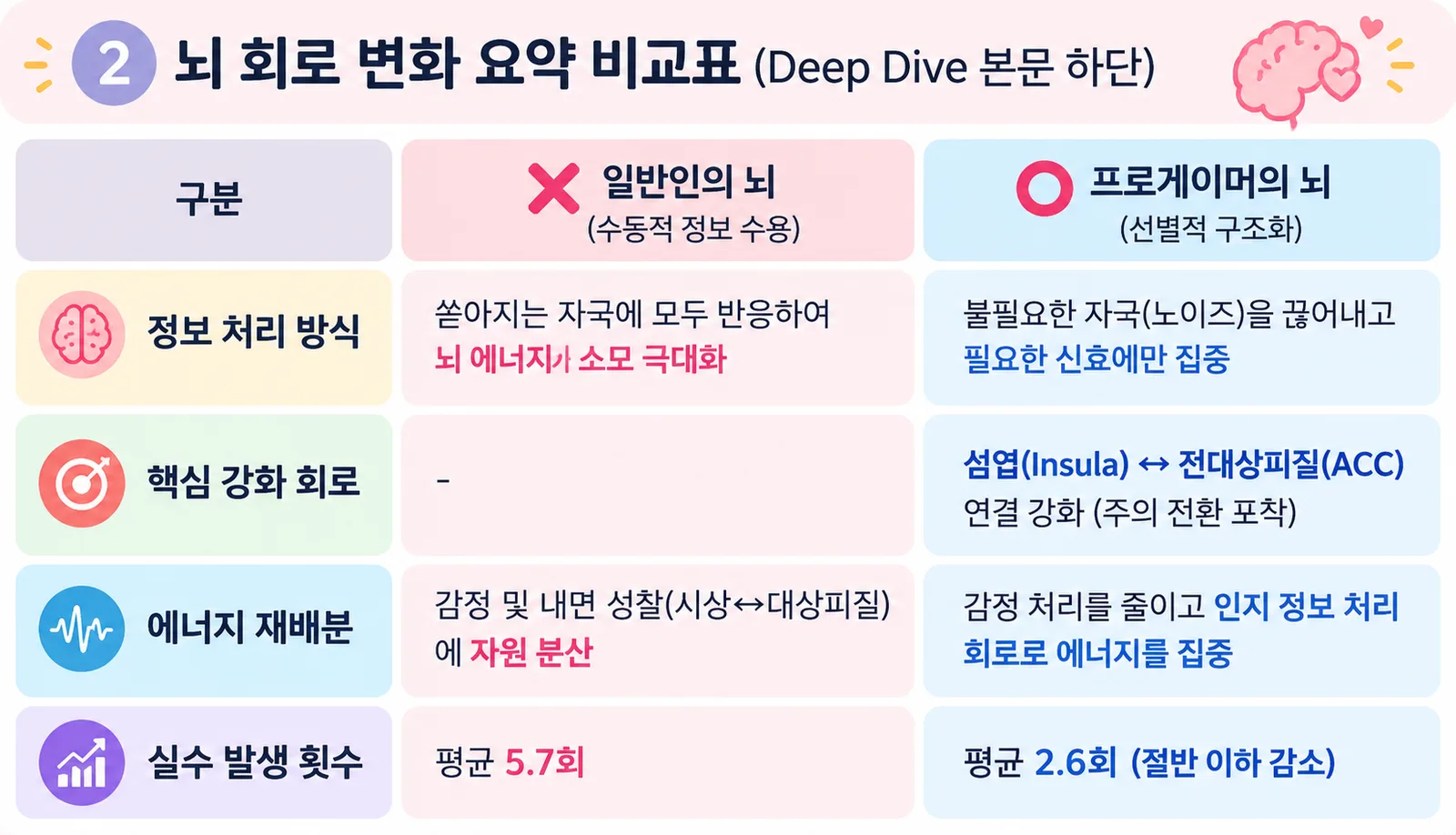 Infographic comparing changes in brain circuits
Three everyday habits for building a “trained brain”
Here are concrete, practical tips for applying the tidying of neural circuits described in the research to daily life and maximizing your brain’s efficiency.
First, run a “mental simulation” (mental rehearsal) before you act
Right before you exercise or start an important task, close your eyes for just three minutes and picture the entire process and every movement you’ll perform. This warms up the brain’s motor areas in advance and cuts down on unnecessary trial and error when you actually do it.
Second, cut out visual stimuli (mirrors and screens) and focus on internal sensations
When you exercise, don’t let your gaze be captured too much by the mirror or your phone screen. Deliberately increase the time you spend focusing on internal sensations, such as your muscles contracting and the rhythm of your breathing (your proprioceptive sense). It strengthens the brain’s attention circuits.
Third, increase “output that selects and reorganizes information” rather than input
Drop the passive habit of simply consuming as many books and videos as you can. Instead, write down by hand, or summarize out loud, the one key line you learned today, building the brain’s muscle for “selecting and organizing” information.
Frequently asked questions
Does gaming for a long time make your brain better?
Playing for a long time doesn’t, by itself, change the brain for the better. In this study, too, the brain changes in pro gamers appeared alongside structured training that included strategy meetings, match analysis, and real-match feedback, not long playing hours alone. Time spent repeating without purpose or feedback is unlikely to lead to neurological adaptation.
What actually changes when the insula and ACC are strengthened?
The stronger the connection between these two regions, the faster you catch unexpected stimuli, and the fewer mistakes you make at moments when you shouldn’t respond. In the study, pro gamers made 2.6 mistakes on average, less than half of non-gamers’ 5.7. This ties directly to split-second accuracy of judgment during a match.
Can this principle be applied to daily life beyond games?
I tried it myself and felt the effect in exercise and study as well. The habit of organizing key sensations or the skeleton of a concept in your head before you start made a real difference to the quality of focus, more than simply putting in time. Starting with your brain already knowing “what to pick” is clearly different from starting without knowing.
Is esports good for young people’s brain development?
With conditions. Based on this study, change appeared in the direction of developing the brain’s attention circuits when the structure of training was in place. Without coaches, a feedback system, and a match-analysis routine, simply playing for a long time is unlikely to produce the same result. Like a school sports team, esports can have educational value when it sits within a systematic ecosystem.
Conclusion
The biggest question this research on pro gamers’ brains left me with was “Am I pouring in time, or am I designing a structure?” There was a time when I believed that looking longer and seeing more was proof of skill; honestly, I now have serious doubts about whether that approach was efficient.
For the brain to change, it needs not repetition, but purposeful repetition: the habit of deciding first what to look at, and consciously deciding what to let go. That is exactly how pro gamers have rewired their brains through more than 10 hours of training a day. Whether it’s study, exercise, or work, this principle applies more universally than you might think. I’d encourage you to choose just one of your current routines and use the 30 seconds before you start as “time to decide what to focus on, and nothing else.” In my case, those 30 seconds changed quite a lot.
Reference: https://www.sciencetimes.co.kr/nscvrg/view/menu/248?searchCategory=220&nscvrgSn=262503
⚠️ About the author’s views, and a note for readers
This post reframes press materials and related articles on a recent neuroscience journal paper (Scientific Reports) through the author’s personal practice and perspective. The effects of neuroplasticity and attention training can differ depending on each person’s physical and mental condition and environment. The training habits and cognitive approaches introduced here are general self-improvement guidance and cannot replace treatment for attention deficit (ADHD) or related neurological conditions. If you have a health condition or need professional treatment, please be sure to consult a medical professional.
Was this article helpful?
Your choice is saved only in this browser and is never sent anywhere.