You stopped at last time.
The story in four panels
15 minutes in nature reboots the brain
-
1The problem
A smartphone with notifications piling up My head is overloaded
Spending directed attention on work and phones all day wears out the prefrontal cortex.
-
2How it works
A person walking beside a tree in the sunshine Nature lets it rest
Rustling leaves and birdsong engage effortless soft fascination.
-
3What to do
A person walking beside a tree in the sunshine A 15-minute green walk
Start with a 15-minute walk, a plant on your desk, and 5 minutes gazing out the window.
-
4The change
A brain with an even wave and a slowly beating heart Focus, switched back on
Cortisol drops, and attention, memory, and emotional balance recover.
There is a science-based way to restore a tired brain in everyday life. According to research in environmental neuroscience, contact with nature alone can quickly restore attention, memory, and emotional regulation. Here is the most effective brain-science solution for calming the prefrontal cortex, overloaded in modern life by smartphones and work demands.
Why your brain is tired: how attention runs out
Our brains run on two kinds of attention. Directed attention, the kind we use when we deliberately concentrate, is essential for work, study, and decision-making, but it can be used up. Checking messenger notifications all day, focusing in meetings, and writing reports gradually drain it.
The problem is that the modern urban environment adds to this fatigue. Concrete buildings, constant stimulation, artificial noise: all of it forces the brain to concentrate. Our brains evolved over millions of years to fit natural environments, and from an evolutionary point of view, the modern city is an unusual and demanding place for them.
The science of how nature restores the brain
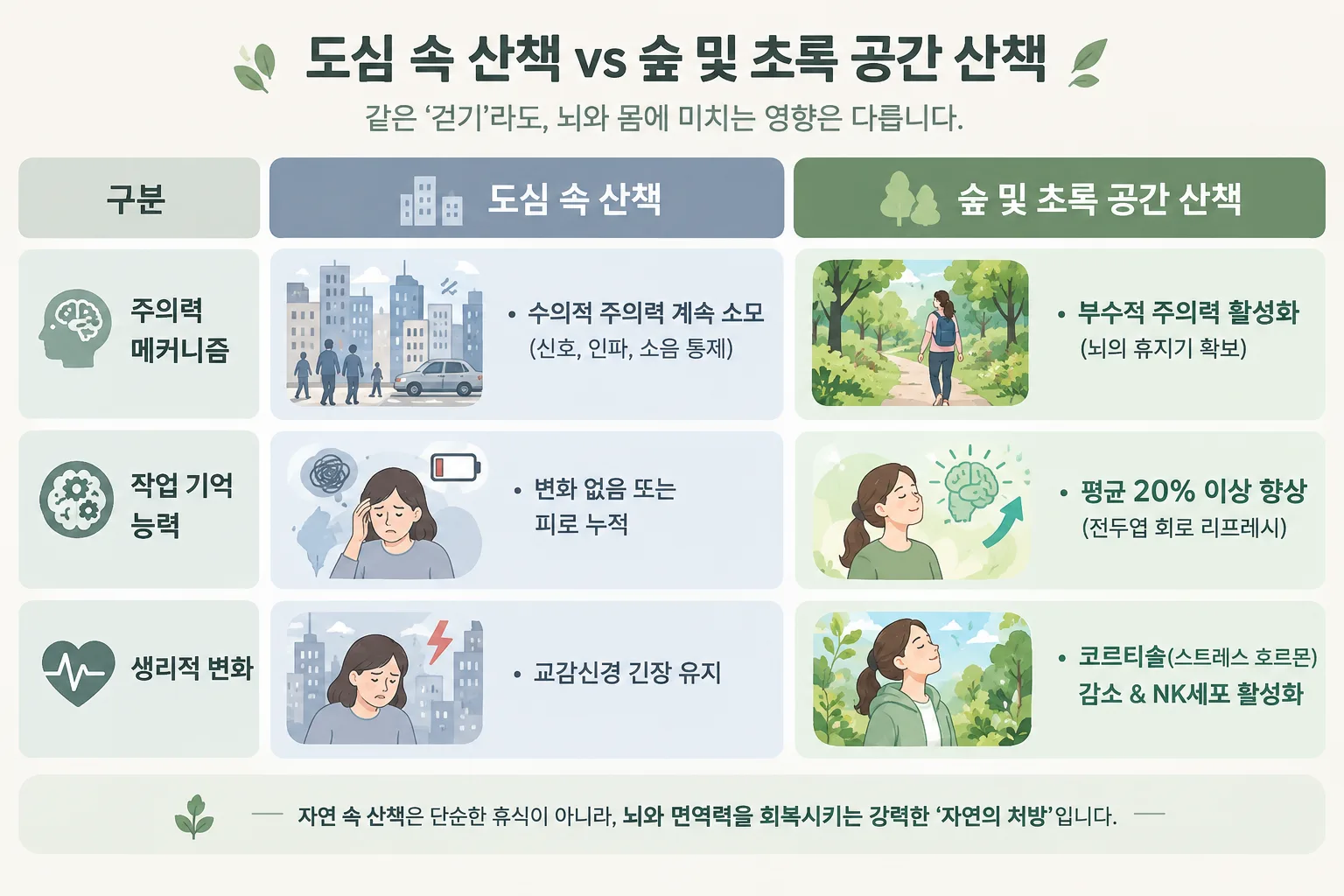
It has been shown that nature goes beyond simply “making us feel calm” and directly restores the brain’s cognitive functions. This is called Attention Restoration Theory (ART).
In nature, the brain enters a state of “soft fascination,” also known as involuntary attention. Swaying branches, birdsong, and running water gently capture our attention without demanding forced concentration. In this state, depleted directed attention recharges and the brain’s fatigue eases.
What the research shows
- City walk vs. nature walk: even for the same 30 minutes of walking, a walk in nature improved memory and working memory by more than 20% on average.
- Lower stress hormones: simply being exposed to green surroundings lowers levels of cortisol, the stress hormone.
- Restored immune function: contact with nature increases the activity of NK (natural killer) cells, strengthening immunity.
A three-step practice to restore your brain
Step 1: Build a 15-minute green walk routine
The most effective and doable method is to put your smartphone in your bag at lunchtime or on your way home and walk quietly for 15 minutes. No elaborate plan is needed. A nearby park or a tree-lined street is enough.
Why 15 minutes? Brain science research suggests that soft fascination kicks in about 10 to 15 minutes after you’re exposed to a natural environment, and brain fatigue then begins to clear rapidly. Think of it not as “a walk” but as time to reboot your brain.
Practice checklist:
- ☐ Set a fixed time: lunchtime or after work
- ☐ Put your smartphone in your bag and silence notifications
- ☐ Choose a route where you can see green: tree-lined streets, parks, waterways
- ☐ Do it at least three times a week (five weekdays is ideal)
Step 2: Bring nature to your desk for visual stimulation
If you can’t leave the office or your room, I recommend placing a small houseplant next to your monitor and looking at it at least once a day. Lively plants like pothos or snake plants work well.
This isn’t mere decoration. Visual green stimulation alone lowers the brain’s tension and reduces stress hormones. Research shows that employees with plants in their workspace are 15% more productive and have significantly lower stress levels than those without.
Step 3: A 5-minute digital detox, gazing out the window
At some point in your day, set a 5-minute alarm and spend that time looking out the window. The sky, branches swaying in the wind, sunlight: anything will do. Don’t try to sort out your thoughts during this time. Just let your mind drift.
This gives a temporary rest to brain circuits on the verge of overload from processing information. This short break greatly improves your afternoon focus and your emotional stability in the evening.
Long-term effects: how brain health carries over into physical health
Regular contact with nature goes beyond short-term recovery from fatigue and improves long-term physical health as well. Lower stress hormones improve gut health, which in turn has a positive effect on immunity and overall metabolism.
In particular, regular time in nature improves sleep quality, which then activates the brain’s glymphatic system, its waste-clearing system, creating a virtuous cycle that restores the brain overnight.
 Everyday tips for reviving a tired brain in nature
Key takeaways
- The brain runs on two kinds of attention, and willpower-based directed attention runs out quickly in modern cities.
- Nature’s soft fascination gently restores the brain without demanding forced concentration.
- A 15-minute green walk, a small plant on your desk, and 5 minutes of gazing out the window are everyday ways to reboot your brain.
- Regular contact with nature has long-term effects: lower stress hormones, better gut health, and stronger immunity.
Conclusion
Living in a complex modern society, brain fatigue is unavoidable. But the way out of it is simpler than you might think. Starting today, at lunch tomorrow, put down your smartphone and look at green for 15 minutes. It is the most fundamental and reliable answer that brain science has shown. No grand plan needed: you can start right now.
Frequently asked questions
I’m a busy office worker and can’t spare 15 minutes every day. Will it still help?
Yes, it will. Brain science research shows that 15 minutes of exposure to nature at least three times a week leads to meaningful improvements in cognitive function. Every day is ideal, but keeping up three lunchtimes and two commutes home a week is enough. Consistency matters more than perfection.
Will indoor plants alone relieve brain fatigue at home?
Indoor plants play a supporting role. Their visual green stimulation and air-purifying effect lower stress, but they can’t fully replace the varied stimulation of a natural environment: sunlight, wind, sound, and humidity. Combining indoor plants with outdoor walks is most effective.
I live in a city without a big park. Does a small tree-lined street help too?
It’s enough. Research shows that both forest walks and walks along urban tree-lined streets help the brain recover from fatigue. What matters is not scale but how long and how attentively you are exposed to green. The key is to put your smartphone away and walk while consciously observing your surroundings.
What should I do when the weather is bad?
Rainy weather is also a good chance to be exposed to nature. The sound of rain, the moist air, and an overcast sky also activate the brain’s soft fascination. Just walk safely with an umbrella. If the weather is truly extreme, it’s fine to substitute gazing out the window or looking at a houseplant indoors that day.
Can this method cure mental health problems like depression or anxiety disorders?
Exposure to nature is a supporting tool for improving mental health, not a replacement for medical treatment. If you have serious mental health symptoms, please see a medical professional. That said, it is very effective for managing everyday stress and brain fatigue.
References
- Kaplan, S. (1995). The restorative benefits of nature: Toward an integrative framework. Journal of Environmental Psychology, 15(3), 169–182. (The founding paper of Attention Restoration Theory)
- Berman, M. G., Jonides, J., & Kaplan, S. (2008). The cognitive benefits of interacting with nature. Psychological Science, 19(12), 1207–1212. (The experiment showing a 20% cognitive improvement after a nature walk)
A question for you
For your brain, which has worked so hard today wrestling with countless words on a screen, which path would you like to follow tomorrow at lunchtime for a 15-minute green break?
(Disclaimer: this article provides brain health information based on research in environmental neuroscience and environmental psychology, and it does not replace professional psychiatric treatment for depression, anxiety disorders, or other conditions.)
Was this article helpful?
Your choice is saved only in this browser and is never sent anywhere.