You stopped at last time.
The story in four panels
Fun routines for a brain that stays young
-
1The problem
A tired person with a lowered head beside an almost empty battery It's on the tip of my tongue…
When the word you meant to say keeps vanishing, you start to worry about your brain.
-
2How it works
Two neurons reaching out and connecting It changes at any age
Neuroplasticity responds to new stimulation regardless of age.
-
3What to do
An open book and a pen Music, art, a new language
Hands-on music and art and learning a foreign language switch the brain back on.
-
4The change
A person asleep under a blanket beneath a crescent moon Sleep and people, too
Sleep is the brain's cleaning time, and connecting with people nourishes the hippocampus.
You turn around and the word you were about to say vanishes from the tip of your tongue. It happened to me quite often. At first I put it down to being tired, but as it kept happening, it started to bother me. That is when I came across the idea of neuroplasticity, and I was honestly surprised to learn that the brain can rewire and strengthen itself even as we age. Just as surprising: you can start with a single everyday hobby, without any elaborate preparation.
In this post, I’d like to share, gently, how neuroplasticity keeps the brain resilient through midlife and beyond, three cognitive hobbies you can easily practice, and tips for brain vitality that draw on sleep and connection.
Does neuroplasticity really work as we age?
When I first encountered the word “neuroplasticity,” I was skeptical. Neuroplasticity is the brain’s capacity to form new synapses, the connections between brain cells, or strengthen existing ones in response to outside stimulation and repeated experience; in some cases, the structure of the brain itself can reorganize. Put simply, it is the brain’s ability to keep repairing and rewiring itself for as long as it lives.
In the past, it was thought that brain cells stopped developing once we finished growing, but neuroscience today takes a different view. According to reports from several research institutions, including the U.S. National Institutes of Health (NIH), as long as the brain receives ongoing intellectual and physical stimulation, its neural networks can form new pathways even after midlife.
Experiencing it myself, I felt that this wasn’t just hopeful theory. When I picked up something I hadn’t touched in years, the first few days gave me a headache and I made little progress. Only later did I realize that the discomfort was a sign of my brain building new pathways. That struggle itself was neuroplasticity at work.
In short: neuroplasticity keeps working after midlife, and unfamiliar, challenging stimulation is actually the signal that forges new synaptic connections.
Your fingertips wake up your brain: music and art
There is a saying that the hand is “the brain extended outward.” That’s because the area of the motor cortex devoted to the fingers is remarkably large. After learning this, I took out the ukulele I had put away long ago. The results were dismal, but the process was fascinating.
While you play an instrument, your brain handles several jobs at once. Reading the score (visual processing), distinguishing sounds (auditory stimulation), and coordinating finger positions (motor control) all interlock in real time. This multisensory integration engages the left and right hemispheres together and helps increase synaptic density. Multisensory integration is the brain’s ability to combine visual, auditory, and tactile information into a single stream.
Creating art works on a similar principle. It calls on planning (deciding what to make), visuospatial judgment (balancing color and form), and fine motor skill (handling a brush or a needle) all at once. In my experience, this one is a little different: it’s fine if the result isn’t polished. I found that the more an activity focuses on the process rather than the result, like calligraphy or knitting, the longer you can keep it up without pressure, which makes it even better for the brain.
- Piano, guitar, ukulele: stimulate score reading, hearing, and motor control at the same time
- Oil painting, watercolor, calligraphy: train visuospatial judgment and fine hand control
- Leathercraft, knitting, embroidery: repetitive hand movements strengthen both focus and cognitive stamina
In short: playing music and making art are the most efficient cognitive hobbies, stimulating many areas of the brain at once through multisensory integration.
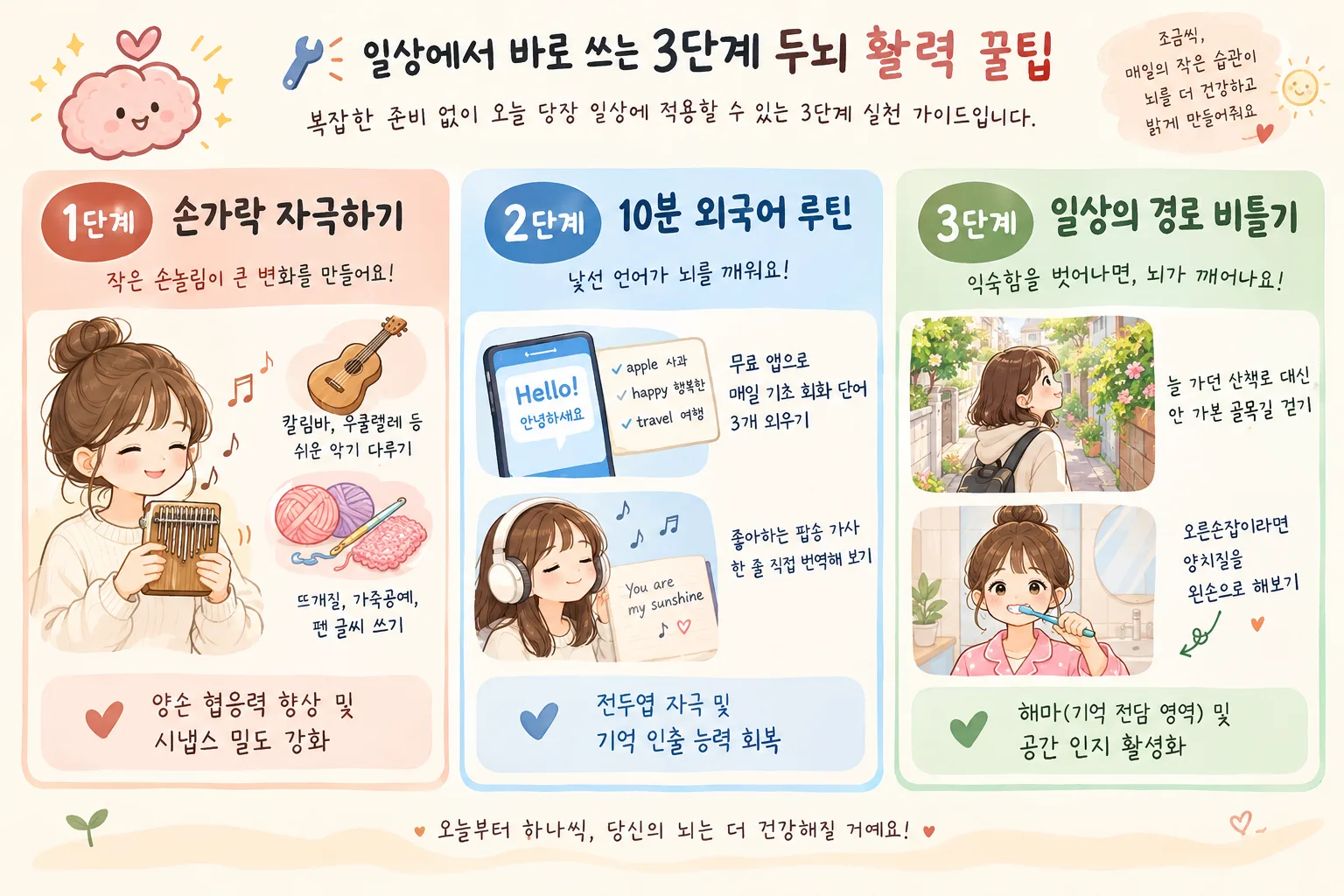 A three-step brain vitality guide you can use every day
One new language switches your brain back on: learning a foreign language
The brain saves energy when stimulation feels comfortable. If every day repeats the same routine, the same language, and conversations with the same people, the brain drops into low-power mode. Learning a foreign language is a highly effective way to shake that safe fence.
Quite a lot happens in the brain when you learn a new language. Imitating unfamiliar sounds stimulates the auditory cortex, and comparing unfamiliar grammar with your native language actively engages the prefrontal cortex. The prefrontal cortex is the core hub of cognitive functions such as judgment, planning, and working memory, and the more it is activated, the more it helps build cognitive reserve. Cognitive reserve is a kind of brain resilience that cushions the effects of aging or damage.
A report from Alzheimer’s Disease International also noted that bilingual people tend to show cognitive decline later than people who speak only one language.
Honestly, this surprised me: there’s no need to start language study in a big way. I began by translating the lyrics of pop songs I love, or reading basic words aloud for 10 minutes a day with a free smartphone app. Even that gave me the feeling that my brain “switched on” every morning, and the feeling lasted a long time.
In short: learning a foreign language stimulates the prefrontal and auditory cortices together, making it the most accessible form of high-intensity brain training for building cognitive reserve.
One hobby isn’t enough: sleep, social connection, and variety
Even while keeping up my cognitive hobbies, I felt something was missing. It turned out that without sleep and connection with other people to support it, the benefits of brain care are cut in half.
Sleep is the brain’s cleaning time. While we sleep, the brain washes away the metabolic waste that builds up during the day, and sorts what we experienced into long-term memory. This process is called memory consolidation. In other words, if you want to remember tomorrow the ukulele chords or foreign words you learned today, you need a good night’s sleep tonight. Securing 7 to 8 hours of sleep a day is more basic, and more essential, than any brain training program.
Connecting with people is also excellent stimulation for the brain. Reading the other person’s expression, grasping the context, and choosing the right words to respond keep the prefrontal cortex working continuously. In my own experience, going to a small group with shared interests for just one month gave me a different kind of alertness than reading alone. Finally, varying your daily routes helps too. Taking an unfamiliar side street instead of your usual path feeds new visual information to the hippocampus, the center of spatial memory and new learning. Regular exposure to new environments is known to help preserve memory.
In short: to get the most out of cognitive hobbies, you also need enough sleep for memory consolidation, social connection that stimulates the prefrontal cortex, and everyday variety that wakes up the hippocampus.
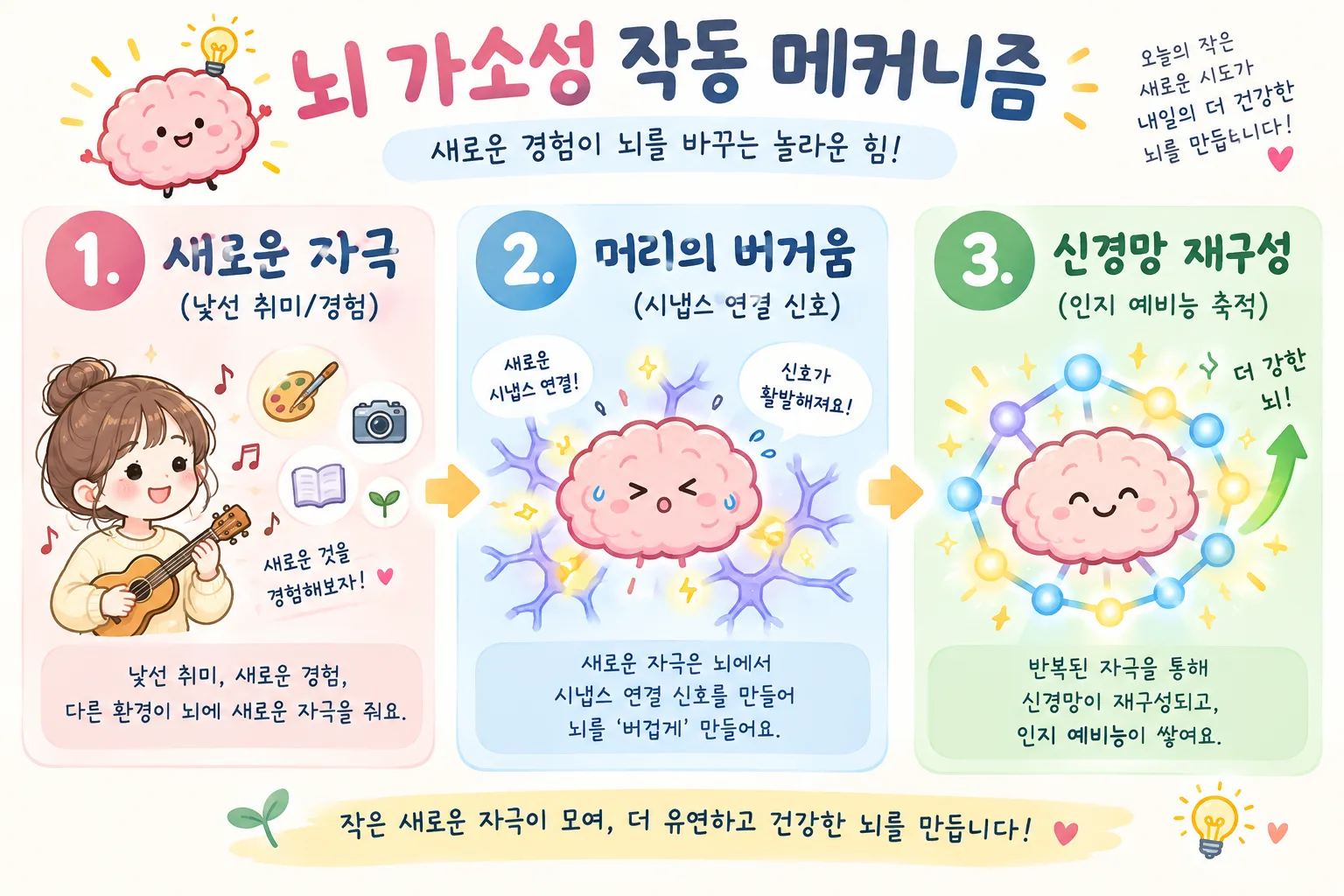 How neuroplasticity works
Frequently asked questions
Does learning a new instrument in midlife really help the brain?
When I tried it myself, I found that the process of learning matters, even if you play badly. Playing an instrument is a multisensory activity that engages visual, auditory, and motor pathways at once, so it stimulates many areas of the brain regardless of your level. Keeping at it matters far more than how polished you are.
Isn’t it too late to start a foreign language when you’re older?
It isn’t too late. In fact, some studies suggest that when you learn a new language after your native language is fully established, comparing and contrasting the two stimulates the prefrontal cortex even more strongly. Starting with 10 minutes a day, or translating a single pop song, is enough.
Do smartphone games or watching YouTube count as brain stimulation?
Passively watching videos and playing puzzle or strategy games that require your brain to respond actively provide different kinds of stimulation. For cognitive training, it’s better to choose interactive content that has you making judgments and choices repeatedly, for no more than about 30 minutes a day. Long stretches of passive viewing can actually put the brain into low-power mode.
If my forgetfulness gets worse, should I see a doctor, or are lifestyle changes enough?
Forgetfulness that doesn’t interfere with daily life can be expected to improve with brain-stimulating habits and good sleep. But if memory problems last more than a few weeks or keep causing trouble in daily life, don’t judge it yourself; it’s safer to consult a neurologist.
Conclusion
I’ve also made grand plans to look after my brain, only to give up within days. So I changed direction completely. No expensive materials: a 10-minute language app, a ukulele I pick up two or three times a week, and a different side street on my way home from work now and then. Those three things are my entire brain health routine today.
What matters is to keep adding new stimulation, and for that stimulation to be enjoyable so it lasts. Neuroplasticity is not a matter of willpower but of environment and habit. I encourage you to pick just one and start right now. If your head starts to ache a little, it means it’s working.
Reference: https://yuyu.co.kr/blog/612ff20d-2f45-4d94-9e2a-0eb3c31c4668/
References
- National Institutes of Health (NIH). Neuroplasticity and Brain Health in Aging.
- Alzheimer’s Disease International (ADI). Bilingualism and Cognitive Reserve Report.
A question for you
What small hobby or change of routine would you like to try to wake up your brain today? Share your own brain vitality routine with us through the contact page.
Disclaimer
This article is written for general health information and cognitive care, and it cannot replace medical diagnosis or treatment. If memory loss or cognitive problems serious enough to affect daily life continue for several weeks, please visit a neurologist or other medical professional to have your condition properly assessed.
Was this article helpful?
Your choice is saved only in this browser and is never sent anywhere.