You stopped at last time.
The story in four panels
For beginner runners with sore knees
-
1The problem
A person running lightly with motion lines My knees ache…
Many people start running and stop within days because of knee and shin pain.
-
2How it works
A running shoe with the curve of the foot arch beneath it Are the shoes to blame?
The foot arch absorbs shock, and shoes that don't match your arch type add strain.
-
3What to do
A running shoe with the curve of the foot arch beneath it The wet footprint test
Check your arch type at home and choose running shoes to match.
-
4The change
A sprout growing from the top of a brain Run long without pain
Running steadily without pain keeps the BDNF and mood benefits coming.
More and more people are taking up running these days. But a great many of them put their running shoes back in the closet within a few days because their knees or shins start aching. When you look for the cause, it’s surprisingly common for it to be shoes that don’t fit, not a lack of skill.
Running shoes that don’t fit your feet may be the hidden cause of knee pain
You’ve probably heard that running is good not only for cardiovascular endurance but also for mood and focus. That’s why many people make up their minds and start, only to end up blaming their shoes after a few days of knee or sole pain. In fact, there’s something to check before the shoes: the shape of your foot arch.
Foot arches differ from person to person, and depending on their shape, the way your foot meets the ground when you walk or run differs too. If you choose running shoes just because they’re pretty or famous without knowing this, it can actually lead to injury. Today I’ve put together, step by step, how to check your foot arch and how to choose running shoes for each type.
Why running is good for brain health
Rhythmic aerobic exercise like running is known to increase blood flow to the brain. More blood flow means a smoother supply of oxygen and nutrients, which is said to have a positive effect on brain areas involved in memory and focus. This is probably also why people who walk or run regularly are said to have lower stress levels.
Of course, running once or twice won’t bring dramatic change; consistency is the key. The problem is that the most common thing blocking that consistency is injury. Beginners in particular often suffer knee, sole or shin pain from shoes that don’t fit and give up partway.

Why you should check your foot arch first
The foot arch is the hollow on the inner side of your sole, and it absorbs shock and distributes your body weight. How low or high the arch is changes how much the foot rolls inward when it touches the ground, which is called pronation. If you choose shoes on cushioning alone without considering pronation, the load can concentrate on certain areas.
In fact, problems such as knee pain or plantar fasciitis in beginner runners are reportedly often caused by a mismatch between arch type and shoe. Of course, if you have pain, it’s safer to get properly checked at a clinic or specialist store than to self-diagnose. Still, knowing your rough foot type in advance makes choosing running shoes much easier.
How to check your foot arch at home
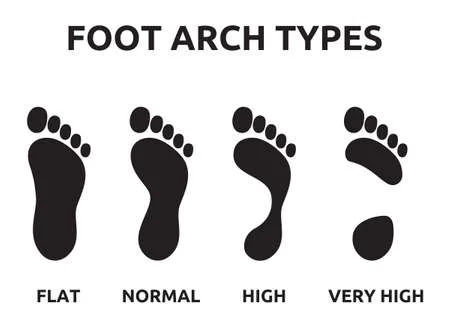
The simplest way is to wet the soles of your feet and leave footprints on dry paper or the floor. By looking at how deeply the inner line of the footprint curves in, you can estimate your arch shape. If the middle of the footprint looks almost continuous, you’re close to flat feet; if instead the footprint looks almost broken, you’re closer to high arches (pes cavus).
Looking at the soles of your old sneakers is also a good hint. If the inner side is unusually worn, you likely pronate heavily; if they’re worn mainly on the outer side, you may tend toward supination. These methods are only for reference, though, so if you’re curious about your exact condition, the gait analysis service at a specialist running store is one option.
How each arch type shows up differently
Flat-footed types with low arches reportedly absorb shock relatively poorly and show marked pronation, with the foot rolling inward. In this case, fatigue tends to build up along the inner foot and shins after long walks or runs. On the other hand, high-arched types don’t distribute shock well and tend to shift the load to the outer edge of the foot, which can leave the soles or ankles stiff.
People with a normal arch somewhere between flat and high are known to get along relatively well with many kinds of shoes. But whatever your type, suddenly increasing your running distance or running for a long time on hard surfaces can cause pain. If pain keeps recurring, regardless of type, I recommend resting and getting an expert’s diagnosis.
How to choose running shoes for your arch type
If you have flat feet or pronate heavily, running shoes with a stability function that keeps the foot from rolling inward reportedly help. Products with firm material reinforcing the inner side or labeled “stability” often fall into this category. On the other hand, if you have high arches, running shoes with rich cushioning that help absorb shock as much as possible tend to suit you better.
With a normal arch, you can consider neutral running shoes, which you can wear comfortably without stability features or excessive cushioning. When you try them on in a store, I recommend checking that there’s about a finger’s width of space in front of your big toe and that the width doesn’t pinch. Visiting a store in the afternoon and walking in them before choosing, rather than buying online, lowers the chance of a bad buy.
Habits beginner runners should build alongside
No matter how well your running shoes fit, increasing distance or speed too much from the start easily causes pain. It’s best to begin by running short distances at an easy pace, giving your body time to adapt. Gently loosening your ankles and calves before and after running also helps prevent injury.
Running shoes are consumables whose cushioning wears down after a certain distance, so it’s also important to check their condition regularly and replace them on time. If you feel pain or warning signs in your feet, rather than gritting your teeth and running on, rest for a few days, and if it continues, it’s safest to see a doctor. As these basic habits add up, you can enjoy running for a long time without injury.
Just checking your foot arch has probably made your criteria for choosing running shoes much clearer. To enjoy the good changes that steady running brings for a long time, please remember that finding shoes that fit your own feet is the first step.
Do you pay attention to your foot arch when choosing running shoes? If you have your own criteria or tips, let me know in the comments.
Was this article helpful?
Your choice is saved only in this browser and is never sent anywhere.