You stopped at last time.
The story in four panels
A post-holiday quick reset guide
-
1The problem
A plate with meat, an egg, and greens, with a fork and knife My stomach feels heavy…
Pancakes, ribs, rice cakes. After the holiday the body is a tangle of fructose, carbs and fat.
-
2How it works
A drop of blood and a glucose meter The blood sugar roller coaster
Cut carbs and blood sugar steadies as the body starts burning fat for fuel.
-
3What to do
A plate with meat, an egg, and greens, with a fork and knife Meat + salt tea + magnesium
Add warm salt tea and well-absorbed chelated magnesium to a carnivore diet.
-
4The change
A brain with an even wave and a slowly beating heart A lighter morning
Avoid poorly absorbed magnesium oxide, and keep going while watching your body's signals.
That heavy feeling that always arrives when the Chuseok holiday ends: I go through it every time. Pancakes, galbi, songpyeon: by the time you’ve patted your belly in front of the table your parents and grandparents prepared and said “That was delicious,” your body is already a tangle of fructose, carbohydrates, and fat. Because I’ve tried it myself, I can say the carnivore diet is surprisingly good at quickly reversing that bloating and buildup. But if you skip magnesium, you’re halfway to failure.
Right after Chuseok: why carnivore?
After a couple of days of holiday food, strangely, you want to eat even more. Partly it’s because your stomach has stretched and your threshold for fullness has gone up, but it’s also because repeated blood sugar spikes keep insulin flowing and make your appetite itself grow. Insulin is the hormone that pushes glucose from the blood into cells to lower blood sugar; the more carbohydrates you overeat, the more of it is released, which promotes fat storage.
The morning after the holiday ends, the first thing I do is drink a cup of warm salt tea on an empty stomach. Then, without eating anything, I walk or jog lightly for at least 30 minutes. This fasted cardio is the key, because it’s effective at burning through the glycogen stored in the liver and muscles. Glycogen is the form in which carbohydrates are stored in the body; only when it’s used up does the body switch into fat-burning mode.
The carnivore diet fits right into this timing. When you eat only animal foods, such as beef, pork, eggs, and butter, insulin levels drop quickly and the body starts using fat as its main energy source. In my judgment, there’s no better combination for getting rid of the bloating caused by holiday foods that mix fructose, carbohydrates, and fat. Being able to use leftover holiday meat, like LA galbi or sanjeok skewers, is another practical advantage. Just avoid marinated galbi made with sugar and malt syrup; stick mainly to salt-grilled meat to get the real benefits of carnivore.
- Carnivore-friendly foods: beef, pork, chicken, eggs, butter, ghee, sea salt
- Using holiday food: skip marinated galbi (sugar, malt syrup); stick to salt-grilled meat and sanjeok
- Double the effect by burning glycogen first with fasted walking or running, then starting carnivore
- Keep it short: limit it to one or two weeks to prevent nutritional imbalance
In short: right after the holidays, burning glycogen with fasted cardio and then starting carnivore is an effective way to quickly reverse bloating and weight gain, and the key is to run it for just one to two weeks.
Why carnivore drains your magnesium
Have you ever had leg cramps or a twitching eyelid a few days into carnivore? When I first started carnivore, on the third night my calf cramped so badly I couldn’t sleep. I didn’t know why at the time, but later learned it was a classic case of the “carnivore keto flu.” The carnivore keto flu is a set of early adaptation symptoms, such as fatigue, headaches, muscle cramps, and insomnia, caused by electrolyte imbalance when you suddenly cut out carbohydrates.
The cause is clear. When you cut out carbohydrates, insulin levels fall, and the kidneys quickly flush out electrolytes such as sodium, magnesium, and potassium along with water. Magnesium is concentrated in plant foods like nuts, legumes, spinach, and bananas, so on a carnivore diet of animal foods only, its supply is cut off altogether. With both factors at play, magnesium deficiency sets in quickly.
Magnesium is an essential mineral for relaxing nerves and regulating muscle contraction; without enough of it, you get not only muscle cramps but also a sharp drop in sleep quality and worse constipation. Because carnivore involves no dietary fiber at all, if magnesium, which helps relax the intestinal muscles, also drops, constipation can become quite painful. In fact, among people I know who tried carnivore and gave up, constipation and sleep problems were common reasons. Getting magnesium right alone makes it a completely different experience.
The effects of magnesium deficiency on health are described in detail by the U.S. National Institutes of Health (NIH) Office of Dietary Supplements, which gives a recommended daily intake for adults of 310 to 420 mg depending on sex.
In short: on carnivore, falling insulin flushes out electrolytes quickly and plant sources are cut off, so magnesium deficiency develops fast and the carnivore keto flu appears.
Types of magnesium and how to supplement in practice
You know magnesium matters, but when you get to the pharmacy, there are so many kinds that it’s hard to know which one to buy, right? I felt the same at first. So let me share my experience of trying and comparing several types myself.
The most common and cheapest is magnesium oxide, a form in which magnesium is bound to oxygen. It’s the most widely used on the supplement market because it’s cheap relative to its content, but its absorption rate is very low, around 4%. It essentially works by irritating the bowel to induce diarrhea, so it’s mainly used as a laxative. It isn’t suitable for magnesium supplementation on carnivore.
What I mainly use right after Chuseok is magnesium gluconate. Magnesium gluconate is a form in which magnesium is bound to gluconic acid; it often comes in liquid form, is absorbed quickly, and is gentle on the stomach. After the holiday, once I finish my fasted workout, I take magnesium gluconate until I get a loose-stool response. Once the body has absorbed as much as it needs, it naturally signals to flush the rest. People whose routines have been regular sometimes respond after two or three sachets, while I’ve seen people who had built up a lot of waste take more than six or seven sachets without any diarrhea. That difference serves as one indicator of each person’s condition.
Chelated magnesium is another option. Chelated magnesium is a form in which magnesium ions are wrapped in organic molecules such as amino acids; it has high bioavailability and few digestive side effects, making it suitable for steady everyday supplementation. It is, however, relatively expensive. After taking magnesium, you’ll find your body relaxing and sleep coming naturally, which is why I recommend taking it after dinner or before bed. Magnesium acts as a natural sedative that relaxes the nerves. After a deep sleep, you’ll wake up to a body in quite a different state from before the holiday. It’s also important to get plenty of mineral-rich sea salt or pink salt along with it. For more on choosing a magnesium supplement, see Healthline — Magnesium Supplements.
In short: avoid magnesium oxide, which is meant as a laxative, and supplement with fast-absorbing magnesium gluconate or chelated magnesium in the evening or before bed to effectively correct the electrolyte imbalance of carnivore.
Common questions about carnivore and cautions for taking magnesium
Should I do carnivore during Chuseok, or after it?
Realistically, perfect carnivore is hard during the holidays. I choose to enjoy the holiday food and start in earnest the day after the holiday ends. During the holidays, it’s practical to run a “semi-carnivore” version, cutting carbohydrates as much as possible by sticking mainly to unseasoned salt-grilled meat and sanjeok.
How long does the carnivore keto flu last?
It varies, but symptoms are usually worst between three and seven days after the switch. Getting enough magnesium and sodium noticeably shortens the symptoms. In my experience, the difference between when I took care with magnesium and when I didn’t was quite large.
How many sachets of magnesium gluconate should I take a day?
There’s no fixed answer. Once the body has absorbed as much magnesium as it needs, loose stools or diarrhea are the signal. When that response comes, I stop supplementing for the day. That said, suddenly taking very high doses can upset your stomach, so I recommend starting with one or two sachets and increasing gradually while watching how your body responds.
Is it okay to eat a lot of eggs on carnivore?
Eggs are one of the core foods of carnivore. Some argue they should be limited because of concerns about saturated fat and cholesterol, but it’s hard to see egg consumption itself as the cause of problems on a carnivore diet. However, avidin, abundant in egg whites, can interfere with biotin absorption, so it’s best to eat eggs fully cooked.
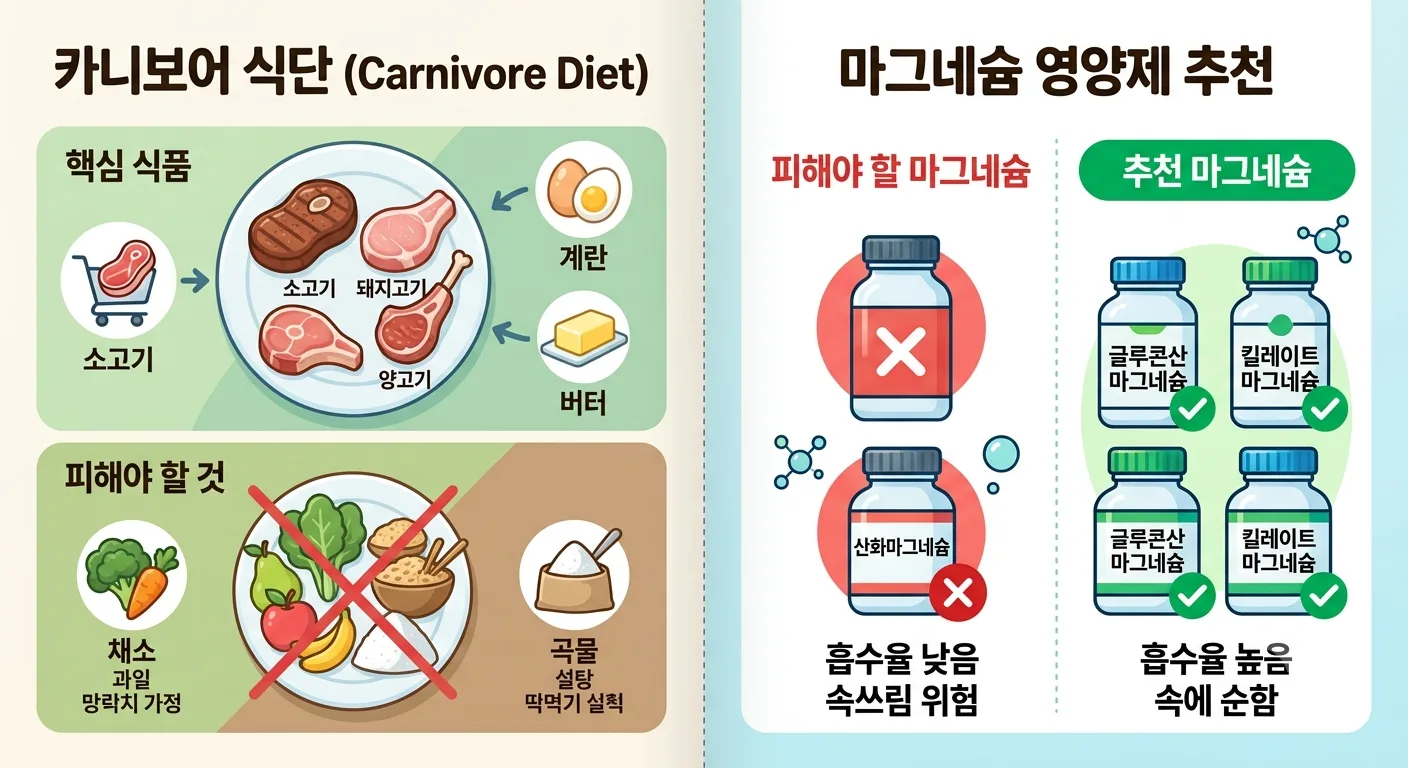 Infographic of carnivore-friendly foods and recommended magnesium supplements
Conclusion
If your body feels heavy and the bloating won’t go away after Chuseok, the carnivore diet is a genuinely effective option for quickly reversing that state. Quickly switching to a diet centered on animal foods to undo the excess insulin created by holiday foods mixing fructose, carbohydrates, and fat, and flushing out water and glycogen, also makes logical sense for short-term weight recovery.
But it’s hard to experience carnivore fully without magnesium. Avoid magnesium oxide; supplement with magnesium gluconate or chelated magnesium in the evening and secure plenty of sleep. That sequence is the post-holiday recovery routine I’ve tried and settled on. Setting a period of one to two weeks and doing it short and strong is, I think, the most practical way to see results without nutritional imbalance.
Reference: Chuseok holiday diet, carnivore, and magnesium — Google search
This post is based on personal experience and general nutrition information, and it cannot replace professional medical diagnosis or treatment. If you have a medical condition or a particular constitution, please consult a specialist or pharmacist before starting.
Was this article helpful?
Your choice is saved only in this browser and is never sent anywhere.