You stopped at last time.
The story in four panels
The placebo is real
-
1The problem
A person breathing shallowly at a desk while an alarm bell rings overhead My knee hurts…
The stronger the pain, the easier it is to think the body is badly damaged.
-
2How it works
A metronome in the brainstem wired by a dashed line to an alarm speaker Pain is a protective signal
Pain isn't an exact measure of damage; it's the brain's response to protect the body.
-
3What to do
A speech bubble coming from a person Expectation and hope
The sham-surgery group had less pain. Expectation and hope move the brain.
-
4The change
A brain with an even wave and a slowly beating heart Understanding instead of fear
A brain with hope instead of learned helplessness helps recovery.
The placebo effect really exists
If you came here wondering whether the placebo effect really exists, see what Dr. Monty Lyman has to say.
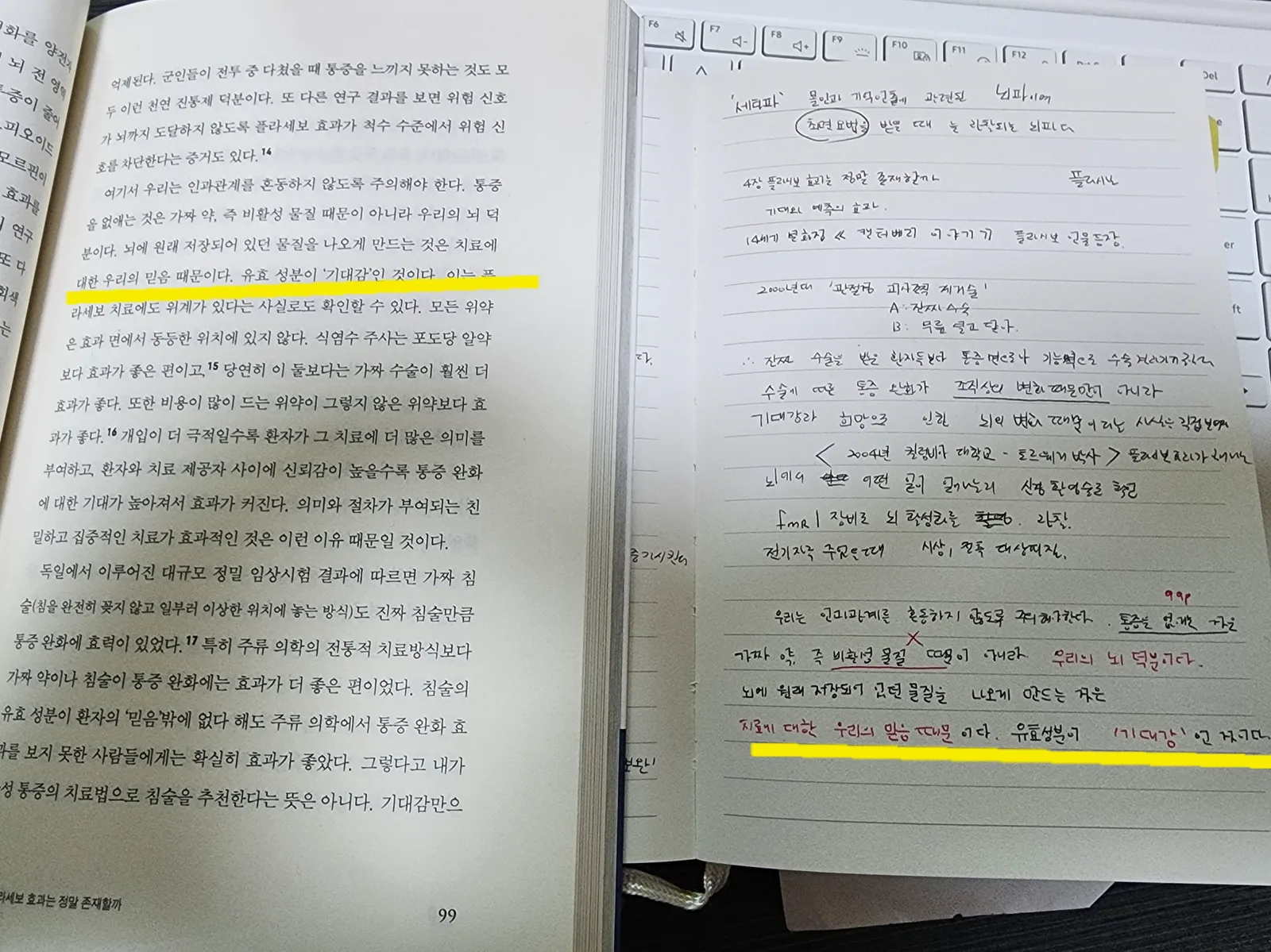
In my last post, I shared the four things I’m doing right now as my secret to success. One of them was reading, and the book I briefly mentioned was Monty Lyman’s The Painful Truth. The book says that if we cling only to the idea that pain is a direct measure of damage, we can’t understand pain’s strange and fickle side. It says the first step in healing body and mind is understanding that pain is a response to protect our bodies and doesn’t necessarily give accurate information about tissue damage (The Painful Truth, p. 34).
In one experiment in the book, patients with knee pain undergo arthroscopic debridement (removing damaged tissue from an arthritic joint). Group A gets the real surgery, while group B only has the knee opened and closed, with no real surgery. Which group do you think showed a more positive change in pain?
Remarkably, group B showed better pain relief after surgery than group A, which had the real operation. Why do you think that is? Have you ever heard of learned helplessness?
Learned helplessness is the state in which, after being exposed to an aversive stimulus and repeatedly learning that you can’t escape it despite trying, you no longer make any effort or attempt to escape even after the stimulus is removed. What matters in learned helplessness is that “expectation” and “hope” have disappeared. Conversely, the placebo effect means pain relief appeared thanks to a brain filled with expectation and hope.
In a way, the book can be difficult, since it covers the history and experiments of neuroscience as it relates to pain, but through it you learn about how to live.
If you feel right now that something hurts, your first reaction shouldn’t simply be to get scared and afraid; you should take the attitude, “Ah, this is to protect my body, so I’ll look after it from now on.”
In life, “expectation and hope” are what move our brains and change them.
No matter where we stand right now.
I’ll end with something a YouTuber said:
“I don’t think success or failure is decided by where a person is right now; I think it’s a person’s mindset that lets them succeed or keeps them where they are.”
(I’ve only read a third of the book so far.)
Was this article helpful?
Your choice is saved only in this browser and is never sent anywhere.